


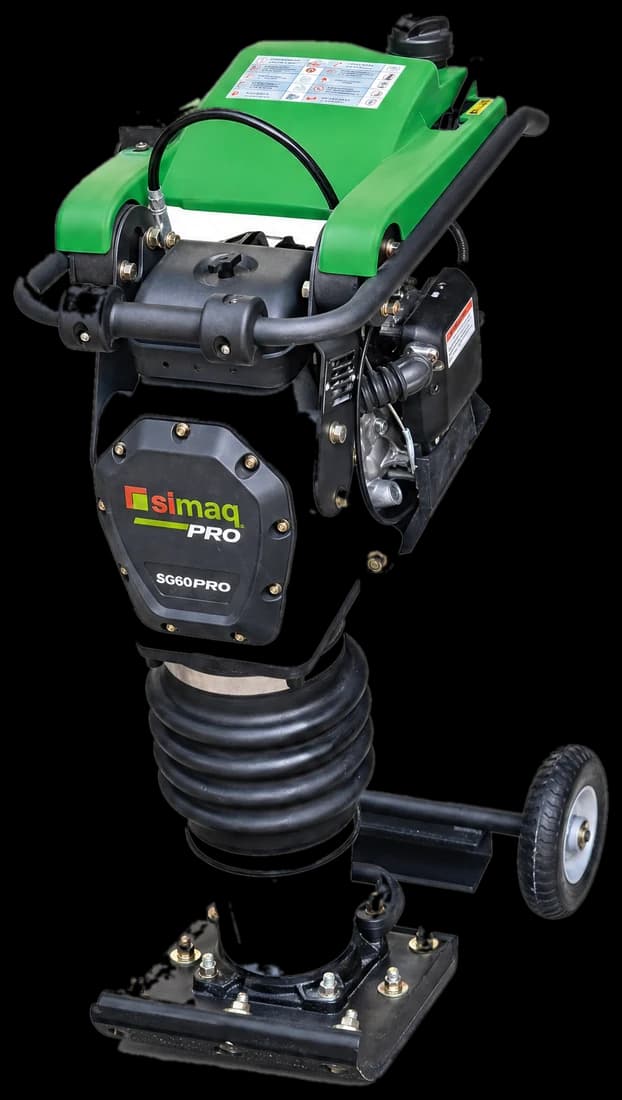
SQ60 PRO 2
Vibratory compactor SQ60 PRO 2
Soil density where the big roller won't fit.
View detailsSolution by job
You pick the compactor by material and space: the SQ60 PRO 2 rammer for trenches and clay, the SQ15 PRO plate for sand, gravel and pavers, and a roller for base and asphalt. The SQ15 PRO plate (Honda GX160) compacts down to 300 mm. On asphalt, the SQRDWB L34 walk-behind roller has a water sprinkler so the mix won't stick to the drum.
Also called: jumping jack, rammer, plate compactor, roller
Field rules
Clay (cohesive) soil = rammer. Sand or gravel (granular) = vibratory plate or roller.
Compact in 20–30 cm lifts. One thick, poorly compacted lift is settlement waiting for a date.
In trenches use a trench roller or rammer: the machine must fit and the operator must stay out of harm's way.
Full throttle before you engage vibration: vibrating at half throttle punishes the clutch and compacts less.
The machines for this job
Does the job call for the full package?
Send all 9 machines to the quote builder at once — adjust quantities and drop what you don't need.
SIMAQ tool
Play with lift thickness and material — target density comes from thin lifts and full passes.
Recommended: 20–30 cm per lift.
85%
Target ≥ 95%
Compact in 20–30 cm lifts: any thicker and the bottom never reaches density no matter how many passes. Watch moisture (optimum is the Proctor value). And passes have diminishing returns: the first does a lot, the sixth almost nothing.
Before you buy, learn
Get a quote without leaving
Want to work it out with an advisor?
Job: Compact soil and asphalt
FAQ
The soil and the space decide. A rammer (jumping jack) for narrow trenches, next to pipe and on clay soils. A vibratory plate for sand, gravel, bases and pavers in open areas. A roller for embankments, sub-base and asphalt. At SIMAQ, the SQ60 PRO 2 rammer (Honda GXR120, 13.7 kN, 69 kg), the SQ15 PRO plate (Honda GX160, 530 × 500 mm plate, compacts up to 300 mm) and the walk-behind and ride-on rollers cover all three stages.
For patching and small areas, the SQ15 PRO plate works: it has a water tank and an asphalt sprinkler kit. For streets, parking lots and long runs, use a roller: the SQRDWB L34 walk-behind (680 mm drum) or the ride-on models. Wet the plate or drum so the hot mix won't stick.
If you're compacting trenches, a trench roller: the SQRPTRC L202 runs by remote control, with the operator out of the trench. For sidewalks, parking lots or patching, the SQRDWB L34 walk-behind (0.84 t). For streets and big base work, a ride-on roller, from the SQRD L41 (0.8 t) up to the 4.2 t SQRD L71 with a Yanmar diesel engine.
Usually 3–4 full passes per 20–30 cm lift, overlapping each pass with the last one. If the material keeps sinking or leaving prints, it needs more compaction or the lift is too thick. Try your case in the calculator on this page.
It's almost always a lift that's too thick or the wrong machine: a plate on clay bounces and doesn't compact. In a trench with clay soil, use a rammer or a padfoot trench roller, and backfill in 20–30 cm lifts.
Tell us about the job and we'll build the package. Same-day reply.


