

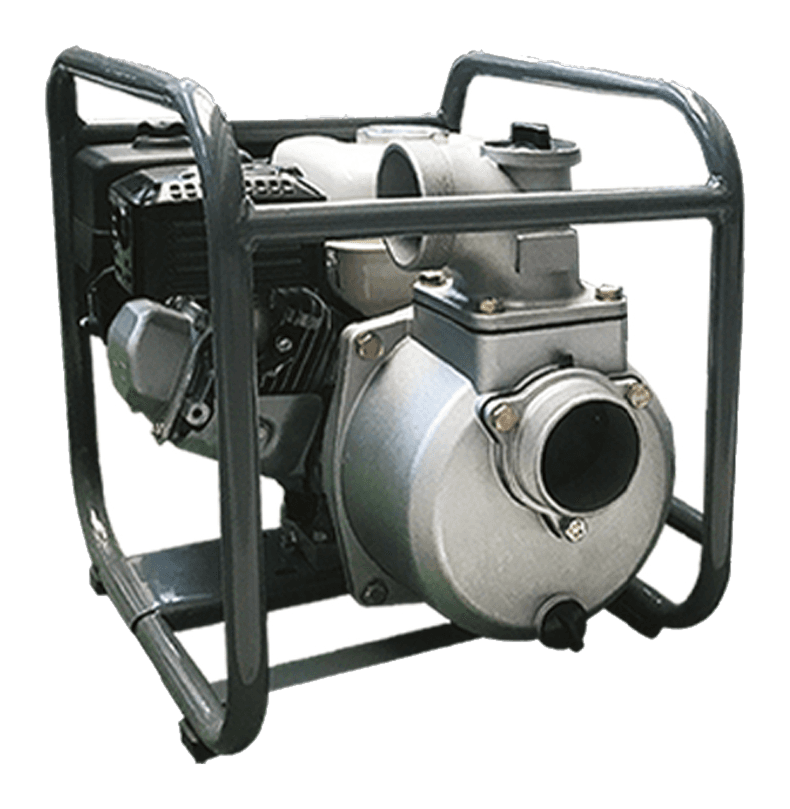
SQWP30 PRO
Water pump SQWP30 PRO
Gets water off the site, fast.
View detailsSolution by job
Dewatering means getting out the water that has collected in a trench, a basement or a flooded area. On site it's done with a pump: prime it, fit the strainer on the suction, keep the suction hose short and send the discharge far away. The 3″ SQWP30 PRO moves up to 30 m³/h and the 4″ SQWP40 PRO up to 40 m³/h. Both lift suction up to 8 m and run on LONCIN engines.
Full step-by-step in the dewatering guideAlso called: trash pump, dewatering pump, water pump
Field rules
Compute total head: suction + discharge + hose losses. Nameplate flow drops fast with head.
Keep suction short and airtight: every extra meter on suction costs double what it costs on discharge.
Strainer always on: one wrong-size rock kills your impeller mid-emergency.
If the water has to go higher than the 3″ can push (13 m total head) → move up to the 4″ (16 m).
Suction hose reinforced and the same diameter as the port: a soft hose collapses under vacuum and the pump stops pulling.
The machines for this job
Does the job call for the full package?
Send all 2 machines to the quote builder at once — adjust quantities and drop what you don't need.
SIMAQ tool
Your jobsite's flow and total head → the 3″ or the 4″, with the real margin at that head.
≈ 300 liters per minute.
Suction + discharge + ~10% extra for hose friction.
Water pump SQWP30 PRO
3″ · LONCIN G200F · total head 13 m
16 m³/h
estimated at 6 m of head
View detailsWater pump SQWP40 PRO
4″ · LONCIN G270F · total head 16 m
25 m³/h
estimated at 6 m of head
View detailsNameplate flow is measured at 0 m of head — at your jobsite's real head it's always lower. Keep at least 15% reserve, keep suction short and airtight, and always run the strainer with solids.
Before you buy, learn
Get a quote without leaving
Want to work it out with an advisor?
Job: Dewater and pump floods
FAQ
Dewatering means getting water out of where it has collected and shouldn't be: a trench, an excavation, a basement, a cistern or a flooded area. On site it's done with an engine-driven pump (dewatering pump) that sucks the water up and sends it away through a discharge hose.
They're the diameter of the suction and discharge ports: 3″ on the SQWP30 PRO and 4″ on the SQWP40 PRO. More inches means more water per hour: 30 m³/h for the 3″ and 40 m³/h for the 4″, per their spec sheets. The hose matches the port diameter; reducing it cuts flow.
Work out the water volume (length × width × depth) and divide it by the flow. A basement of 8 × 10 m with 50 cm of water is 40 m³: at least 1 h 20 min with the 3″ (30 m³/h) and at least 1 hour with the 4″ (40 m³/h). «At least», because real flow drops the higher the water has to go and the longer the hose.
Fill the casing with water (priming), connect the suction with the strainer on and start it. Send the discharge far from where you're pumping so the water won't flow back. Never start it dry.
A trench or basement with medium flow → the 3″ SQWP30 PRO (30 m³/h, 13 m total head). A large flooded area or water that has to go higher → the 4″ SQWP40 PRO (40 m³/h, 16 m). The calculator on this page tells you which one for your flow and head.
The 3″ up to 30 m³/h and the 4″ up to 40 m³/h: that's their maximum. The higher the water has to go and the longer the hose, the less real flow you get.
Most often: it wasn't primed, the suction hose is leaking air, or the pump sits more than 8 m above the water. Check the couplings, move the pump closer to the water and prime it again.
It handles water with mud and suspended solids, typical of jobsites and floods. Always use the strainer: one big stone can break the impeller.
Tell us about the job and we'll build the package. Same-day reply.
