

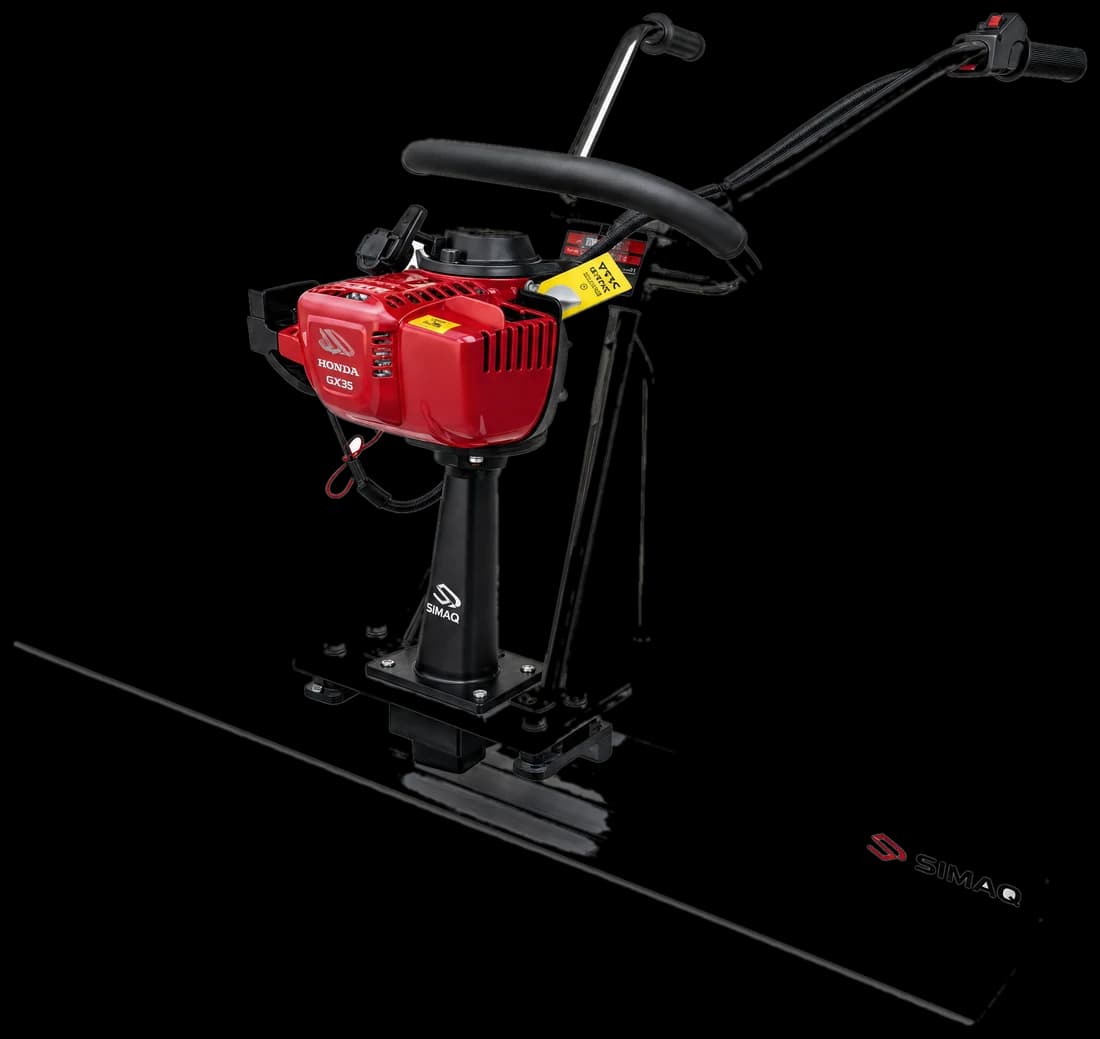
SQRVA1.2SET
1.2 m vibrating screed SQRVA1.2SET
Levels and vibrates the slab in one pass.
View detailsSolution by job
A slab comes out right in three steps: screed with a vibrating screed while the concrete is fresh, trowel once a boot print sinks 3–5 mm, and cut joints at ¼ of the thickness. To screed, the SQRVA1.2SET (1.2 and 3 m blades) or the 6 m SQRVA6M PRO. To finish, the SQ36 PRO power trowel or the SQ36DOUBLE PRO ride-on.
Also called: power trowel, helicopter, vibrating screed
Field rules
Start troweling when a boot print sinks 3–5 mm, not before: going in early scars the slab.
Large, open slabs = ride-on double trowel; slabs with columns and small bays = walk-behind. On large slabs with edges, both.
Saw control joints the same day, 1/4 of slab depth. Late = the slab cuts itself (cracks).
Move the screed at a steady pace without stopping: if you stop, it pulls up too much paste and leaves a mark.
The machines for this job
Does the job call for the full package?
Send all 4 machines to the quote builder at once — adjust quantities and drop what you don't need.
Before you buy, learn
Get a quote without leaving
Want to work it out with an advisor?
Job: Pour and finish slabs
FAQ
When you step on the slab and the boot print sinks 3–5 mm. Earlier, the blades dig in and mark the slab; much later, the surface won't close. Start with the float pan, then switch to the blades.
For a house, garage or shop slab, the walk-behind SQ36 PRO (Honda GX160, 78 kg, 870 mm working diameter) is enough. For an industrial or large warehouse slab, the SQ36DOUBLE PRO ride-on (Honda GX690, 20 HP) covers far more area per hour with one operator.
For narrow panels, sidewalks or ramps, the SQRVA1.2SET (Honda GX35, with 1.2 and 3 m blades). For a wide slab, the 6 m SQRVA6M PRO: it assembles in 1, 2 and 3 m sections and handles layers up to 200 mm.
No. The screed vibrates and levels the surface; the immersion vibrator drives air out from inside. On thick or heavily reinforced slabs, vibrate with the poker first, then run the screed.
The most common cause is cutting the joints late. Concrete shrinks as it sets and, with no joint, it cracks wherever it wants. Cut the same day, at ¼ of the thickness, wet.
Tell us about the job and we'll build the package. Same-day reply.