Guide · 6 min
When should you cut concrete control joints, and how deep?
Also called: contraction joints, control joints, saw cuts
By the SIMAQ technical team · Grupo ConstruMarket ·
Short answer
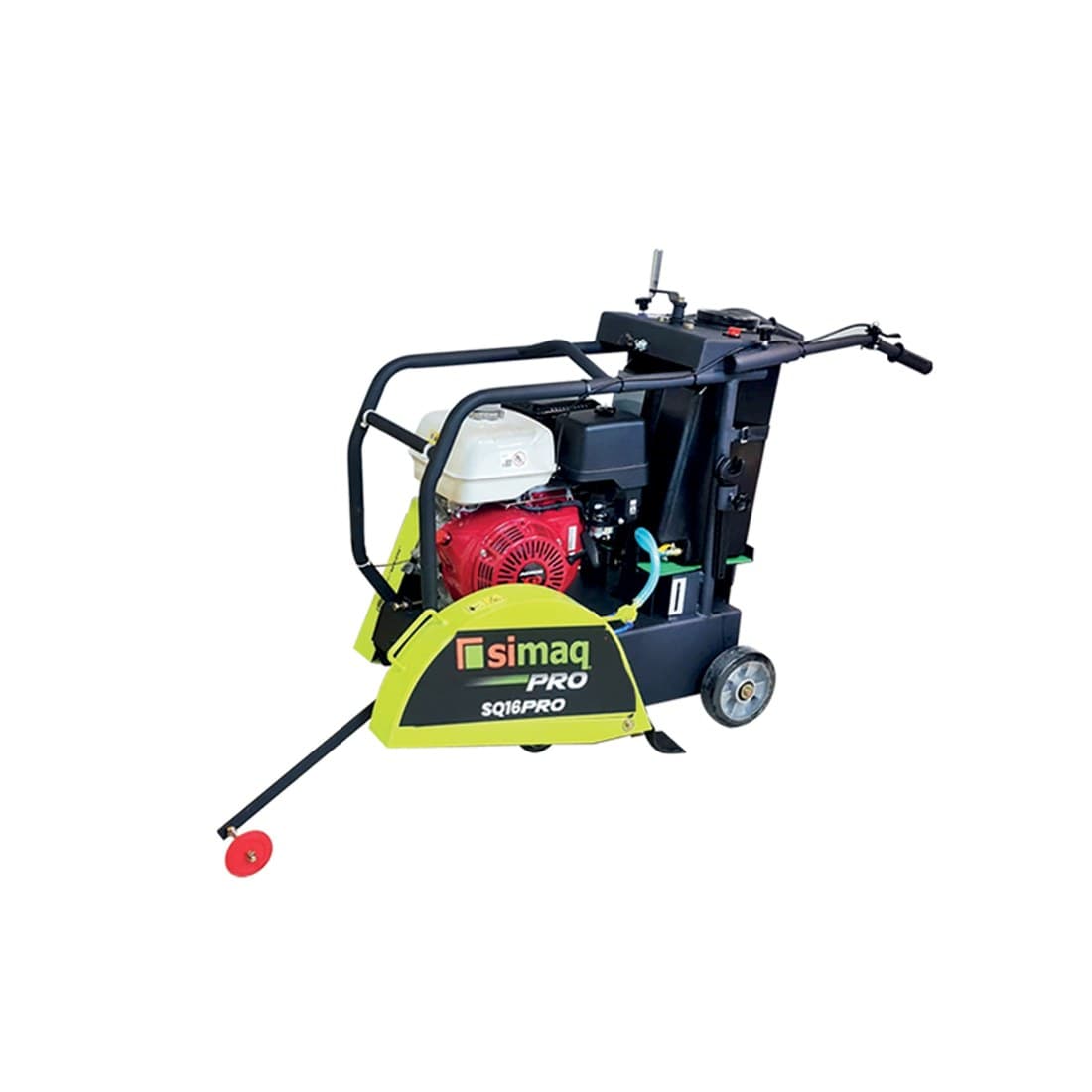
Cut as soon as the slab bears the saw without raveling aggregate, usually 6 to 18 hours after the pour depending on weather and mix, and at ¼ of the thickness: 2.5 cm on a 10 cm slab, about 4 cm on a 15 cm one. Use wet cutting and a diamond blade; the SIMAQ SQ16 PRO saw (Honda GX390, 13 HP) cuts up to 130 mm deep with 300 to 450 mm blades.
of the slab thickness
typical cutting window
SQ16 PRO max cut
Why the slab needs joints
Concrete shrinks as it sets and dries. Since the slab can't shrink freely, it cracks. That will happen no matter what; what you decide is where. A control joint is a cut that weakens the slab along a straight line, so the crack starts there and not just anywhere.
A badly made joint —late, too shallow or crooked— doesn't do its job. The crack gets there first, runs beside the cut or crosses the panel diagonally, and afterwards there's no hiding it.
When: not too early, not too late
The moment is as soon as the slab bears the saw's weight and the blade doesn't pull stones out of the cut edge. Make a short test cut at an edge: if it comes out clean, it's time; if it crumbles and loosens aggregate, wait a little.
The typical window is 6 to 18 hours, but weather shifts it. In heat, sun and wind, the slab sets fast and the window comes earlier. In cold or damp weather, it comes later. If you're torn between waiting and cutting, cut: waiting too long lets the crack beat you.
How deep: ¼ of the thickness
Joint depth is a quarter of the slab thickness. Deep cuts are made in passes of 2 to 5 cm, not all at once: the blade stays cool, the engine isn't strained and the cut runs straight.
| Slab thickness | Joint depth (¼) | Passes of 2–5 cm |
|---|---|---|
| 8 cm | 2 cm | 1 |
| 10 cm | 2.5 cm | 1 |
| 12 cm | 3 cm | 1 |
| 15 cm | 3.75 cm (≈ 4 cm) | 1–2 |
| 20 cm | 5 cm | 1–2 |
| 25 cm | 6.25 cm (≈ 6.5 cm) | 2 |
Where the joints go
Spacing is set by the slab design; the field rule is to keep panels as square as possible, with no long, narrow strips, which crack across. Also cut at re-entrant corners (where the slab forms an «L»), around columns and bases, and in line with the joints of neighboring slabs.
Before cutting, snap a line with chalk line or marker and follow the saw's guide. A crooked joint is a crooked crack.
Wet cutting and the right blade
Always cut wet: water cools the diamond blade, controls dust and extends its life. The SQ16 PRO has a 30 L water tank and manual depth adjustment, and includes two 400 mm (16″) concrete blades. Asphalt calls for a specific asphalt blade.
When finished, wash the slurry out of the cut before it dries and, if the project calls for it, seal the joint with the specified material.
Common mistakes
- Cutting the next day: the crack has already appeared on its own.
- Cutting less than ¼ of the thickness: the crack doesn't follow the cut.
- Cutting dry: the blade overheats and dust goes everywhere.
- Using an asphalt blade on concrete, or the other way round.
- Leaving long, narrow panels.
- Forcing full depth in a single pass.
Takeaway
Cut early (as soon as the slab bears it, usually 6–18 h), at ¼ of the thickness, in 2–5 cm passes, in square panels and with water. The SQ16 PRO reaches 130 mm, has a 30 L tank and two 400 mm concrete blades. Request a quote here and an advisor will contact you during business hours.
Keep going
Take it to the job site
Print the checklist to go over it on site, or send the guide to your crew.
Frequently asked
How deep are slab joints cut?
At ¼ of the thickness: 2.5 cm on a 10 cm slab, about 4 cm on a 15 cm one, 5 cm on a 20 cm one.
How many hours after the pour do you cut joints?
Usually 6 to 18 hours, as soon as the slab bears the saw without raveling. Heat brings it forward; cold delays it.
What happens if I cut joints late?
The slab cracks first, wherever it wants, and the joint no longer guides the crack.
Concrete or asphalt blade?
A diamond blade specific to each material. The SQ16 PRO includes two 400 mm concrete blades.
Can you cut joints dry?
It isn't recommended: water cools the blade and controls dust. Always cut wet.
SIMAQ · Job site checklist
When should you cut concrete control joints, and how deep?
Cut as soon as the slab bears the saw without raveling aggregate, usually 6 to 18 hours after the pour depending on weather and mix, and at ¼ of the thickness: 2.5 cm on a 10 cm slab, about 4 cm on a 15 cm one. Use wet cutting and a diamond blade; the SIMAQ SQ16 PRO saw (Honda GX390, 13 HP) cuts up to 130 mm deep with 300 to 450 mm blades.
Avoid
- Cutting the next day: the crack has already appeared on its own.
- Cutting less than ¼ of the thickness: the crack doesn't follow the cut.
- Cutting dry: the blade overheats and dust goes everywhere.
- Using an asphalt blade on concrete, or the other way round.
- Leaving long, narrow panels.
- Forcing full depth in a single pass.
Job site:
Date:
Supervisor:
Scan it for the full guide, with video and FAQ
https://simaq.pro/en/recursos/corte-de-juntas-de-control-cuando-y-profundidad