Guide · 8 min
How to compact soil: step by step, by hand or with a machine
Also called: plate compactor; rammer or jumping jack
By the SIMAQ technical team · Grupo ConstruMarket ·
Short answer
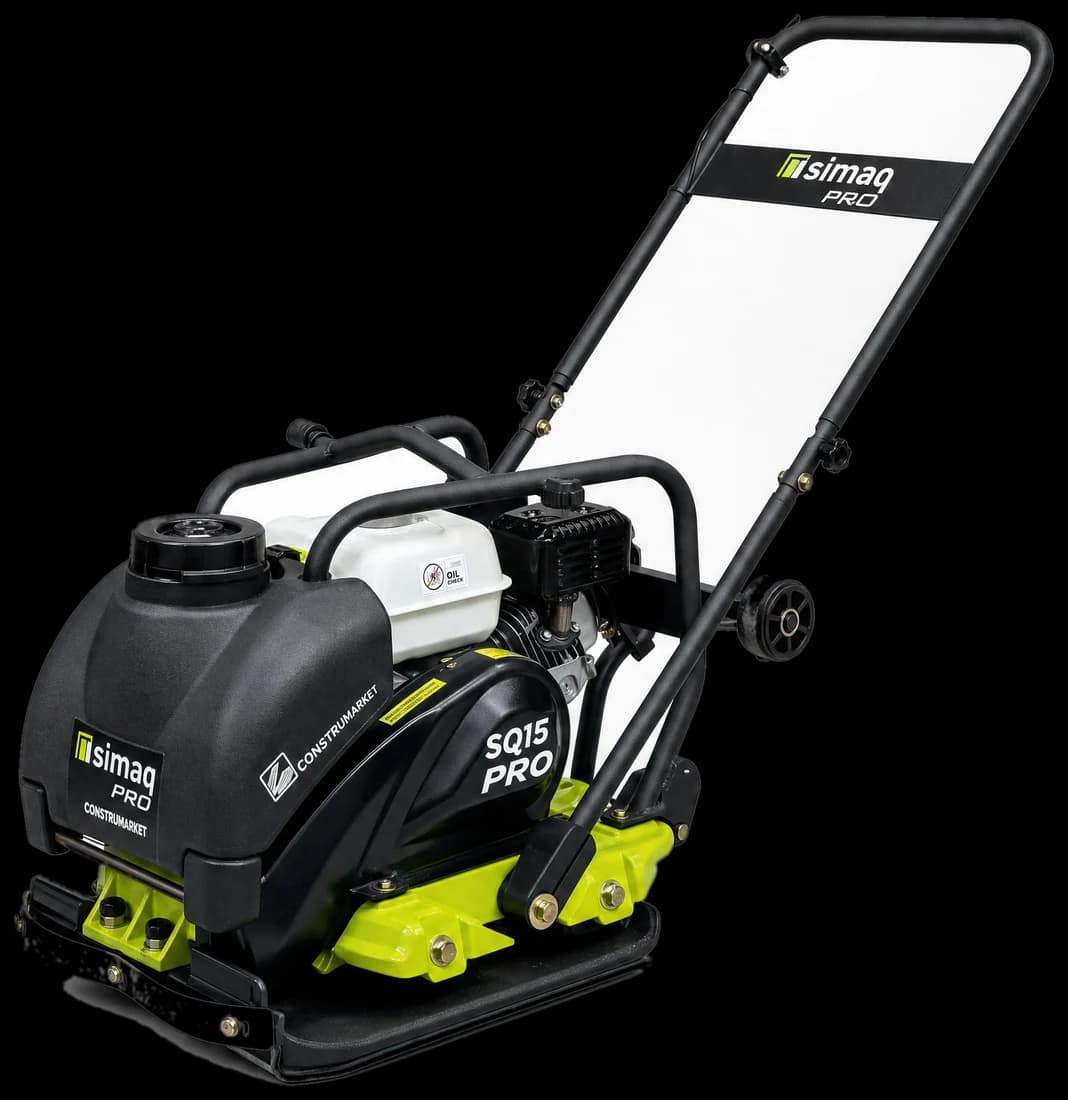
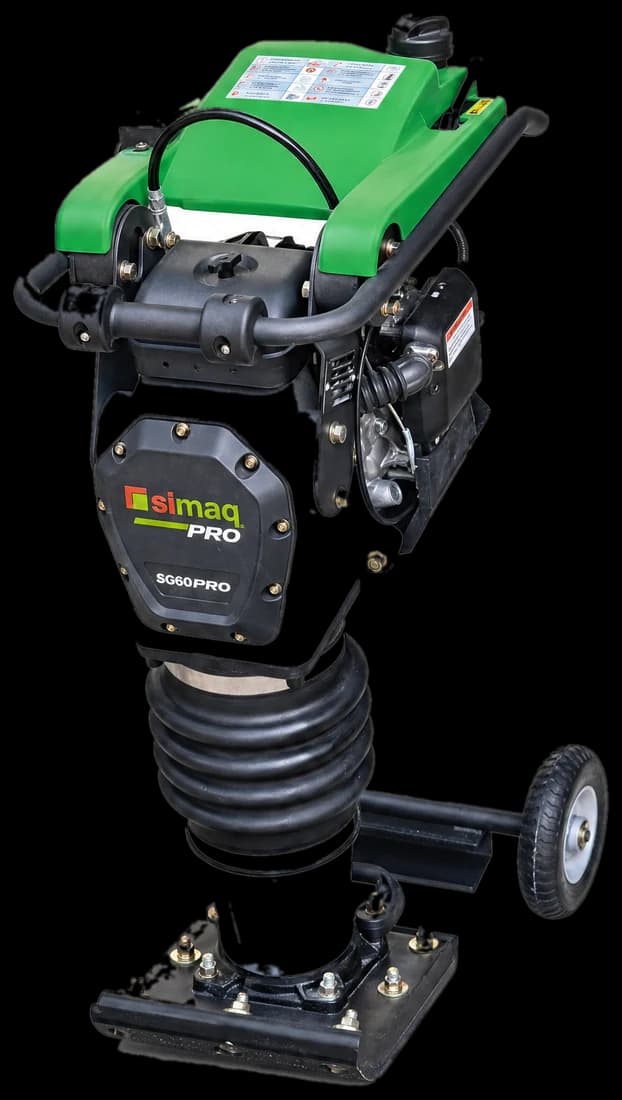
To compact soil: clear out what doesn't belong, check what soil you have, bring it to the right moisture (in clay or earth, a ball squeezed in your hand holds its shape without dripping; in sand or gravel, dark and damp without releasing water), spread it in thin, even lifts and give each lift its passes before the next one goes on. With an SQ15 PRO plate in sand or gravel, lifts of 25 to 30 cm and 4 passes; in mixed soil, 15 to 20 cm and 5 passes. Clay and trenches call for the rammer: lifts of 20 to 30 cm loose and 3 to 4 passes. It's done when the machine stops sinking and barely leaves a mark. By hand it only works for small fills.
plate lift in sand or gravel
passes per lift with a plate
loose lift with a rammer
Before you start: clear it and know your soil
Remove roots, rubbish, mud and large stones: none of it compacts and it leaves voids that sink later. If you're filling, use even material without big clods.
Then look at what soil you have, because that decides the machine. Sand, gravel and crushed base (granular soil) compact by vibration, with a plate. Clay and silt (cohesive soil) compact by impact, with a rammer. If a squeezed handful of damp soil forms a sticky ball, it's cohesive; if it crumbles, it's granular.
Moisture: neither dust nor mud
Moisture matters as much as the machine. Dry soil won't settle and kicks up dust; with too much water it moves like jelly and never firms up. The site test depends on the soil. In clay, silt or clayey earth, squeeze a handful: if it holds as a ball without dripping water, it's right; if it falls apart as dust, it needs water; if it drips, it has too much. In sand or gravel don't expect a ball: even at the right moisture it crumbles when you open your hand, because that's what granular soil does. There, go by colour and feel: at the right point it looks dark and leaves your palm damp without releasing water; if it runs loose and pale like dry sugar, it needs water; if water squeezes out or it puddles, it has too much.
- If it's dry, water it evenly with a hose or watering can and wait for the water to soak in before compacting.
- If it's soaked, let it dry out or swap the material: compacting mud doesn't work.
- Sign from the machine: if the ground pumps or sinks, it's too wet; if it stays loose however many passes, it's too dry.
Lifts and passes with a machine
The rule broken most often: soil is compacted in lifts, never the whole fill at once. A thick lift looks firm on top and stays loose underneath; months later, the floor sinks. These are the loose-lift thicknesses and passes for each machine. If your project calls for another thickness, the spec rules:
- Work in straight strips, from the edges towards the centre, overlapping each strip on the last.
- Full throttle on both machines: at half throttle the plate skids and the rammer gets damaged.
- Next to pipes, walls and manholes, thinner lifts and the rammer.
| Soil | SQ15 PRO plate | SQ60 PRO 2 rammer |
|---|---|---|
| Sand, gravel, base (granular) | 25–30 cm · 4 passes | Works where the plate won't fit |
| Mixed | 15–20 cm · 5 passes | 20–30 cm · 3–4 passes |
| Clay or silt (cohesive) | Won't compact | 20–30 cm · 3–4 passes |
By hand: when it works and how
Tamping by hand, with a hand tamper or mallet, works for small fills that won't carry weight: around a post, a planter, the bottom of a manhole. The method is the same as with a machine, in miniature: soil at the right moisture, thin lifts, even blows overlapping each one on the last, and a check before the next lift.
For a floor, a sidewalk, a slab or a pipe trench, hand tamping doesn't reach the density the job needs, and there's no way to know how much reached the bottom of the lift. That's machine work: a plate for open areas and granular soil, a rammer for trenches and clay.
How to know it's compacted
On site, the most reliable sign is that the machine stops sinking and the surface no longer changes from one pass to the next. With the rammer, when it starts bouncing instead of sinking, the soil is dense. If the job calls for a compaction percentage, a lab tests your material: compact with that test in mind, not with how it looks.
- It barely leaves a mark → that lift is done: spread the next one.
- It keeps sinking after the passes → the lift is too thick or the moisture is wrong.
- The plate bounces and won't move forward → it's probably clay: switch to the rammer.
Common mistakes
- Dumping all the fill and compacting only the top: the bottom stays loose and sinks later.
- Compacting dry soil that kicks up dust, or mud that moves like jelly.
- Using the plate on clay: it vibrates on top and doesn't compact.
- Not overlapping strips: loose bands stay between one pass and the next.
- Hand-tamping the fill of a street trench or of a floor.
Takeaway
Clear it, check the soil, bring it to moisture (in clay, a ball that doesn't drip; in sand, damp without releasing water), spread thin lifts and make the passes before the next one: a plate in sand or gravel (25–30 cm, 4 passes; mixed 15–20 cm, 5), a rammer in clay and trenches (20–30 cm loose, 3–4). It's done when the machine stops sinking. By hand, only small fills. Ask for a quote here and an advisor in your country will confirm which compactor your soil needs.
Keep going
Take it to the job site
Print the checklist to go over it on site, or send the guide to your crew.
Frequently asked
How do you compact soil step by step?
Clear the area, check the soil type, bring it to the right moisture, spread a thin, even lift, compact it with the passes it needs and check the machine no longer sinks before the next lift goes on.
How many passes does soil need?
With an SQ15 PRO plate, 4 passes in sand or gravel and 5 in mixed soil. With a rammer, 3 to 4 passes per lift. Always at the right moisture.
Do you have to wet soil to compact it?
Yes, if it's dry. Water it evenly and wait for it to soak in. It's right when, in clay or earth, a squeezed handful stays in a ball without dripping; sand or gravel won't form a ball: it looks dark and damp without releasing water. Too wet won't compact either.
Can you compact soil by hand?
For small fills that won't carry weight, yes: thin lifts, the right moisture and even blows. For floors, sidewalks, slabs or pipe trenches, use a plate or a rammer.
What does tamping soil mean?
It's compacting it with blows, with a hand tamper or a rammer. It works better than a plate's vibration in clay and in trenches.
SIMAQ · Job site checklist
How to compact soil: step by step, by hand or with a machine
To compact soil: clear out what doesn't belong, check what soil you have, bring it to the right moisture (in clay or earth, a ball squeezed in your hand holds its shape without dripping; in sand or gravel, dark and damp without releasing water), spread it in thin, even lifts and give each lift its passes before the next one goes on. With an SQ15 PRO plate in sand or gravel, lifts of 25 to 30 cm and 4 passes; in mixed soil, 15 to 20 cm and 5 passes. Clay and trenches call for the rammer: lifts of 20 to 30 cm loose and 3 to 4 passes. It's done when the machine stops sinking and barely leaves a mark. By hand it only works for small fills.
Moisture: neither dust nor mud
- If it's dry, water it evenly with a hose or watering can and wait for the water to soak in before compacting.
- If it's soaked, let it dry out or swap the material: compacting mud doesn't work.
- Sign from the machine: if the ground pumps or sinks, it's too wet; if it stays loose however many passes, it's too dry.
Lifts and passes with a machine
- Work in straight strips, from the edges towards the centre, overlapping each strip on the last.
- Full throttle on both machines: at half throttle the plate skids and the rammer gets damaged.
- Next to pipes, walls and manholes, thinner lifts and the rammer.
How to know it's compacted
- It barely leaves a mark → that lift is done: spread the next one.
- It keeps sinking after the passes → the lift is too thick or the moisture is wrong.
- The plate bounces and won't move forward → it's probably clay: switch to the rammer.
Avoid
- Dumping all the fill and compacting only the top: the bottom stays loose and sinks later.
- Compacting dry soil that kicks up dust, or mud that moves like jelly.
- Using the plate on clay: it vibrates on top and doesn't compact.
- Not overlapping strips: loose bands stay between one pass and the next.
- Hand-tamping the fill of a street trench or of a floor.
Job site:
Date:
Supervisor:
Scan it for the full guide, with video and FAQ
https://simaq.pro/en/recursos/como-compactar-tierra-paso-a-paso