Guide · 8 min
Parts of a plate compactor and a rammer: what each part does
Also called: plate compactor; rammer or jumping jack
By the SIMAQ technical team · Grupo ConstruMarket ·
Short answer
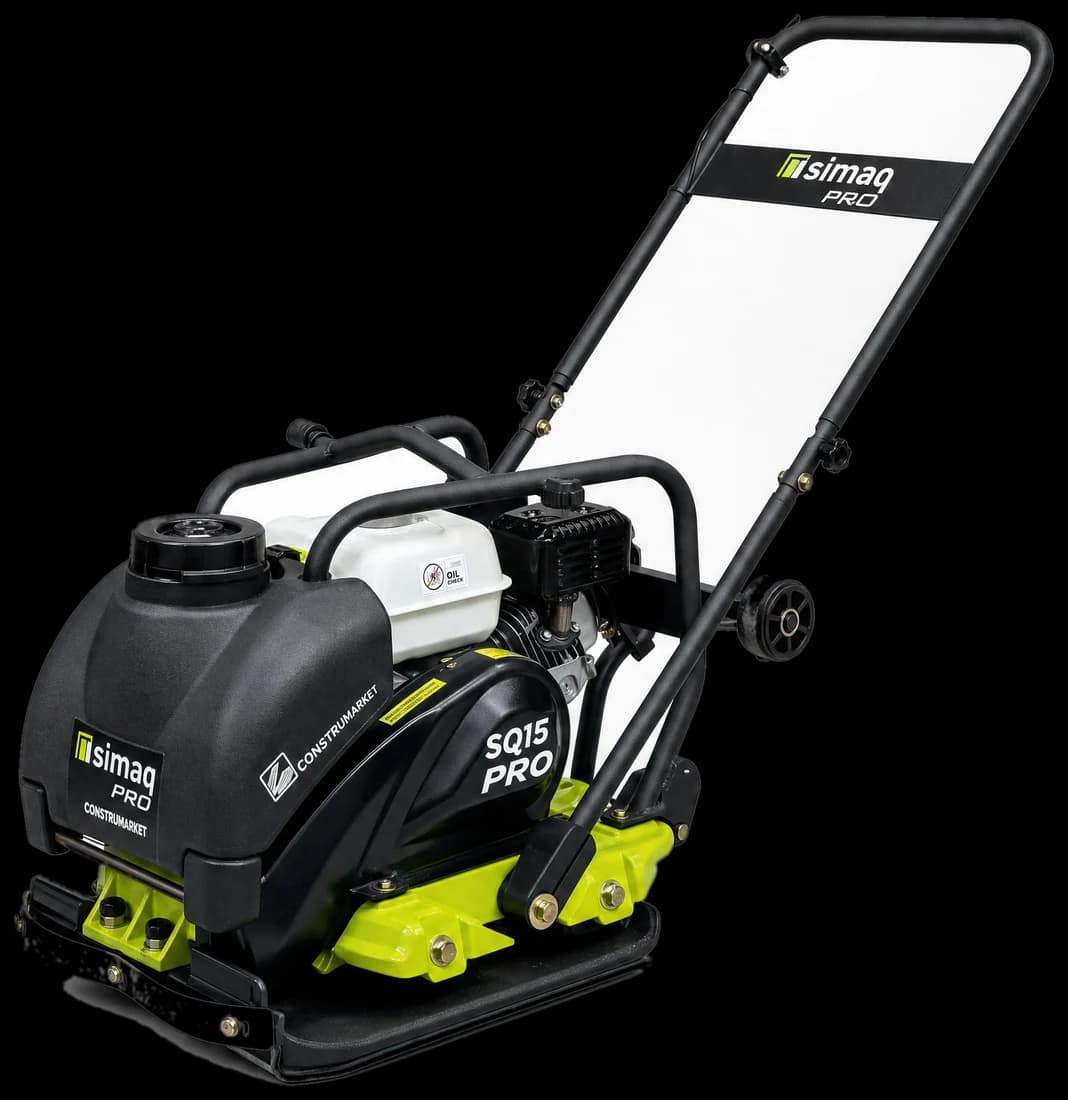
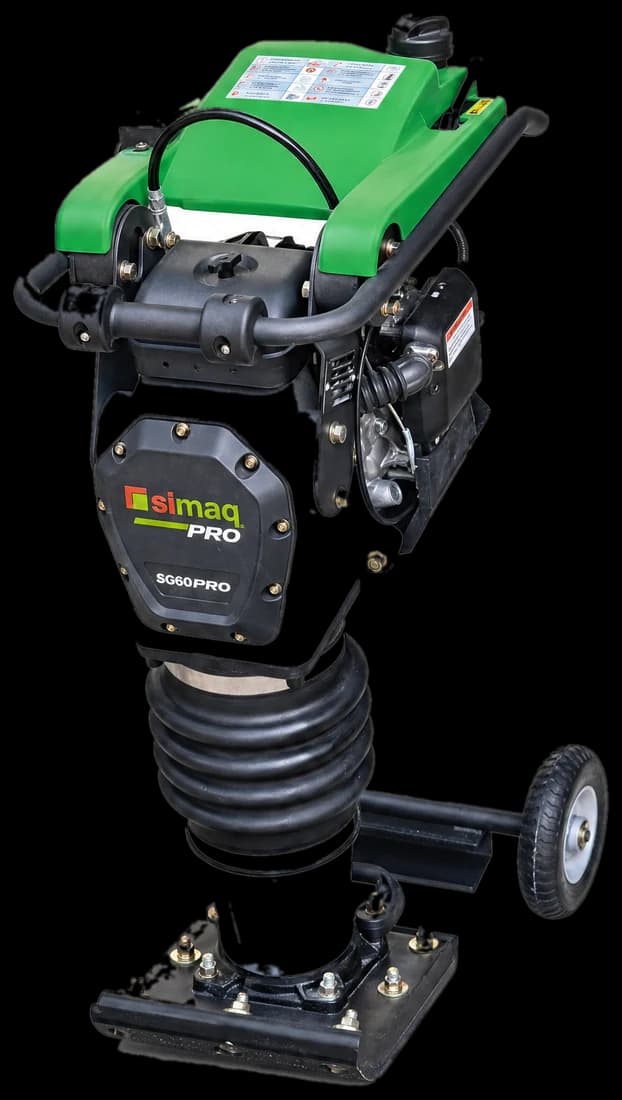
A plate compactor has two halves joined by rubber shock mounts. On top, the engine, handlebar and belt cover. Below, the plate and the vibrator housing, with an eccentric shaft running in an oil bath. Power goes from the engine to a centrifugal clutch, then through a V-belt to the vibrator. A rammer has the engine on top, a gearbox with a connecting rod that turns rotation into blows, a spring box covered by a bellows with an oil bath, and at the bottom the shoe that strikes the ground.
plate belt deflection (manual)
or monthly: plate vibrator oil
of oil in the rammer's bath (manual)
Plate and rammer: two ways to compact
The plate compacts by vibration: a wide plate that shakes and settles sand and gravel grains. The rammer compacts by impact: a narrow shoe that jumps and strikes, kneading clay. That's why they're so different inside, even though both run a Honda engine and a centrifugal clutch.
Parts of the plate compactor
Names from the SIMAQ SQ15 PRO manual and parts list (Honda GX160 engine, 530 × 500 mm plate).
| Part | What it does |
|---|---|
| Engine and mounting plate | Provides the power. It sits on the engine base. |
| Centrifugal clutch | Engages on its own as you throttle up (between 2,300 and 2,600 rpm on the SQ15 PRO). |
| V-belt and cover | Carries the spin from the clutch to the vibrator pulley. |
| Vibrator housing with eccentric shaft | The off-centre shaft spins and makes the plate vibrate. It runs in an oil bath. |
| Vibrating plate | The part that touches the ground and compacts. |
| Rubber shock mounts | Join the engine base to the plate and stop vibration travelling upwards. |
| Handlebar and throttle lever | For steering. It has its own shock absorber. |
| Water tank, valve and pipe | Wets asphalt so it doesn't stick. On the SQ15 PRO, 12 L. |
| Transport wheel and mat | The wheel to move it around the site; the mat so pavers don't chip. |
How power flows in the plate
As you throttle up, the centrifugal clutch engages and turns the pulley; the V-belt carries that spin to the vibrator pulley, which turns the eccentric shaft inside its housing. The vibration goes down into the plate and the machine's weight does the rest.
If the plate vibrates weakly or on and off, the first suspect is the belt: the manual calls for 10 to 15 mm of deflection when pressed midway between the two pulleys. Slack, it slips and vibration drops. The second is throttling up in one go: if you open the throttle slowly, the clutch slips and burns.
Parts of the rammer
Names from the SIMAQ SQ60 PRO 2 manual and parts list (Honda GXR120 engine, 34 × 29 cm shoe).
| Part | What it does |
|---|---|
| GXR120 engine with guard | An engine built for rammers: it runs tilted without flooding. |
| Pre-cleaner and air filter | Two stages that stop dust before it gets into the engine. |
| Clutch and drum | Engages when you open the throttle fully. |
| Gearbox, pinion, crankshaft and connecting rod | Turn the engine's spin into the up-and-down that strikes. |
| Spring box (inner and outer spring) | Store and return the energy of each blow. |
| Bellows and oil sight glass | The bellows covers the springs and holds the oil bath; the sight glass shows the level. |
| Shoe (foot) | Laminated wood with a hardened steel plate: the part that strikes the ground. |
| Handlebar, throttle and stop switch | To steer it, make it strike and stop it. |
| Fuel tank and shut-off valve | A 2.8 L plastic tank that won't rust. |
How power flows in the rammer
At full throttle, the centrifugal clutch engages; the gearbox and connecting rod turn the spin into an up-and-down motion, and the spring box turns that into blows of the shoe against the ground. The SQ60 PRO 2 delivers 13.7 kN of impact, per its spec sheet.
The manual is clear: the throttle goes from idle to full in one move and you always work at full throttle. At half throttle you damage the springs and the clutch.
What to check and what wears on each
| SQ15 PRO plate | SQ60 PRO 2 rammer | |
|---|---|---|
| Every day | Engine oil; clean under the plate; check the rubber mounts | Clean engine and controls; check bellows and spring box for oil leaks; retighten bolts |
| Every week | Vibrator oil level, with the machine level | Tank filter and spark plug |
| Oil in the compacting end | Vibrator oil: monthly or every 200 hours | Oil bath: every 200–300 hours (the first at 50); level at mid sight glass |
| Wears | V-belt, clutch, shock mounts, wheels | Shoe, springs, bellows, clutch, shock absorber |
Common mistakes
- Throttling up slowly: on both machines the clutch slips and burns.
- Running the rammer at half throttle: it damages the springs and the clutch.
- Leaving the plate's belt slack «because it still vibrates».
- Forgetting the plate's vibrator oil or the rammer's oil bath: only the engine oil gets checked.
- Letting soil build up under the plate: the plate drags and won't move forward.
Takeaway
The plate is engine, clutch, V-belt, an eccentric shaft in an oil bath and the plate, separated by rubber shock mounts. The rammer is engine, clutch, connecting rod, a spring box with bellows and oil bath, and the shoe. On both: full throttle in one move, and oil checked in the compacting end too, not just the engine. Ask for a quote here and an advisor in your country will confirm the machine or the part.
Keep going
Take it to the job site
Print the checklist to go over it on site, or send the guide to your crew.
Frequently asked
What are the parts of a plate compactor?
Engine, centrifugal clutch, V-belt and cover, vibrator housing with eccentric shaft, plate, rubber shock mounts, handlebar with throttle, and on the SQ15 PRO a water tank, transport wheel and paver mat.
What are the parts of a rammer?
Engine (GXR120 on the SQ60 PRO 2), pre-cleaner and air filter, clutch, gearbox with connecting rod, spring box, bellows with oil bath and sight glass, shoe, handlebar with throttle and fuel tank.
Why is my plate vibrating weakly?
It's almost always a loose or worn V-belt: it should give 10 to 15 mm when pressed between the pulleys. It also happens if you throttle up slowly and the clutch slips, or if soil is stuck under the plate.
Does the plate take oil besides the engine?
Yes: the vibrator housing runs in an oil bath. On the SQ15 PRO you check it weekly, with the machine level, up to the plug, and change it monthly or every 200 hours, with SAE engine oil.
What oil goes in the rammer's bellows?
On the SQ60 PRO 2, 10W-30 engine oil, about 800 cc, with the level at mid sight glass. The first change is at 50 hours and then every 200 to 300 hours.
SIMAQ · Job site checklist
Parts of a plate compactor and a rammer: what each part does
A plate compactor has two halves joined by rubber shock mounts. On top, the engine, handlebar and belt cover. Below, the plate and the vibrator housing, with an eccentric shaft running in an oil bath. Power goes from the engine to a centrifugal clutch, then through a V-belt to the vibrator. A rammer has the engine on top, a gearbox with a connecting rod that turns rotation into blows, a spring box covered by a bellows with an oil bath, and at the bottom the shoe that strikes the ground.
Avoid
- Throttling up slowly: on both machines the clutch slips and burns.
- Running the rammer at half throttle: it damages the springs and the clutch.
- Leaving the plate's belt slack «because it still vibrates».
- Forgetting the plate's vibrator oil or the rammer's oil bath: only the engine oil gets checked.
- Letting soil build up under the plate: the plate drags and won't move forward.
Job site:
Date:
Supervisor:
Scan it for the full guide, with video and FAQ
https://simaq.pro/en/recursos/partes-de-la-plancha-vibratoria-y-de-la-bailarina