

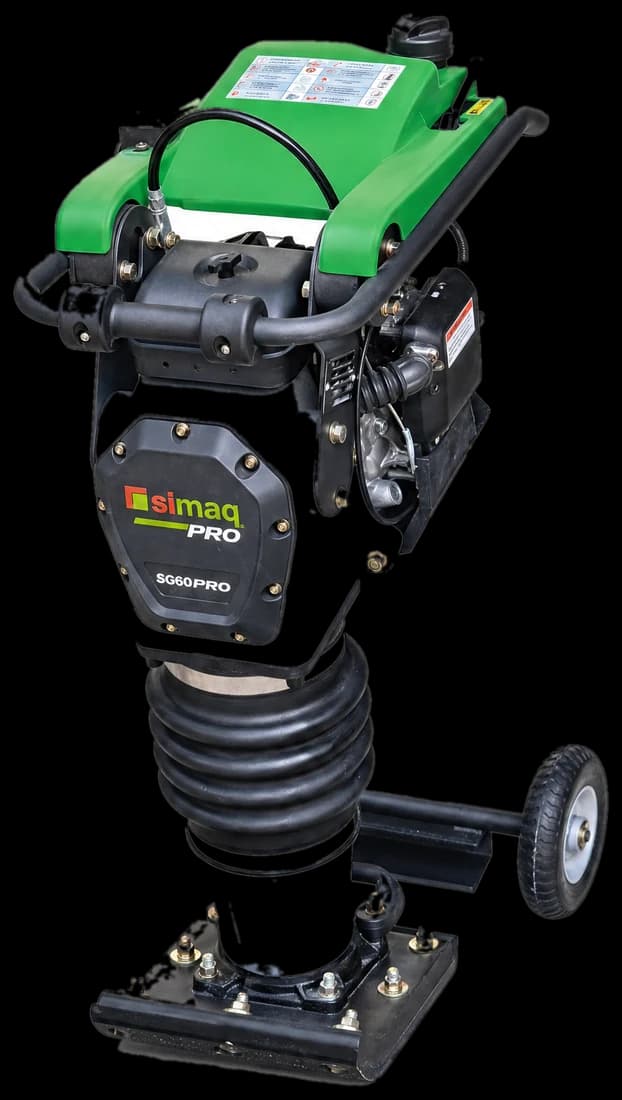
SQ60 PRO 2
Vibratory compactor SQ60 PRO 2
Soil density where the big roller won't fit.
View details5-minute training
5 minA rammer (jumping jack) compacts by impact: the shoe strikes and kneads the soil, which makes it the machine for narrow trenches and clay soils. Run it at full throttle, in 20–30 cm lifts with 3–4 overlapping passes, and let it walk itself forward. The SIMAQ SQ60 PRO 2 has a Honda GXR 120 engine, 13.7 kN of impact force and a 34 × 29 cm shoe.
Also called: jumping jack, tamper, impact rammer
The rammer compacts by impact: the shoe jumps and kneads the soil. It's the machine for narrow trenches, backfill next to walls and pipe, and cohesive soil (clay, silt). If the soil is sand or gravel in an open area, a plate covers ground faster.
Engine oil and the base oil-bath level (through the sight glass), clean air filter and fuel. Shoe free of cracks and loose bolts.
Start and let it warm a few seconds at idle. The rammer shouldn't jump until you give it throttle.
At half throttle it bounces and gets unruly. Full throttle delivers all the impact force and it self-advances: you just steer.
Lifts of 20–30 cm max. If the soil is dry and loose, dampen it; if it's soaked, let it dry out: the shoe sticks and pumps mud.
3 to 4 passes per lift, overlapping each lane. Next to pipe, compact the sides first and go over the top only once there's enough cover.
Do this
Avoid this
Safety
Test yourself
Each practice: do it or avoid it? Tap your answer.
Never leave it running while laid on its side.
Keep the shoe flat against the ground, not tilted.
Let it self-advance; your job is to steer, not push.
Don't run it half-throttle — it bounces and punishes your wrists.
Don't expect miracles on dry loose granular: cohesive soil is its job.
If the soil is dry, bring it to optimum moisture: it compacts far better.
If there's pipe in the trench, compact the sides before going over the top.
Don't compact lifts over 30 cm: the bottom stays loose no matter how many passes.
Equipment in this training
Buying guides
Granular or cohesive, base or trench: the rule is simple — the soil decides. A quick guide so you don't over-buy or redo the work.
Read Guide · 8 minThe plate vibrates with an eccentric shaft driven by a belt; the rammer strikes with a connecting rod and springs. Each one's parts, how power gets from the engine to the ground and what to check and what wears.
Read Guide · 8 minClear it, bring it to the right moisture, spread thin lifts, make the passes and check before the next one. How thick each lift, how many passes with a plate or rammer, how to tell the moisture is right and how to know it's done.
ReadFAQ
It's the rammer: an impact compactor whose shoe strikes the ground hundreds of times a minute (680 on the SQ60 PRO 2). It's nicknamed for the way it hops, and it's built for trenches and clay soil.
Clay, silt or a narrow trench → rammer. Sand, gravel, base or pavers in an open area → plate. The guide on choosing a soil compactor (plate, rammer or roller) goes deeper.
3 to 4 passes per lift, in 20–30 cm lifts, overlapping each lane. If the lift is thicker, the bottom never compacts no matter how many passes you make.
Almost always it's half throttle. Run it wide open: at half throttle it bounces, loses impact force and punishes your wrists.
On the SQ60 PRO 2, the base oil bath gets its first change at 50 hours and then every 200 hours. Check the engine oil and the sight-glass level before every use.
Get a quote without leaving
Want to work it out with an advisor?
Tell us about the job and we'll build the package. A rep replies during business hours.