

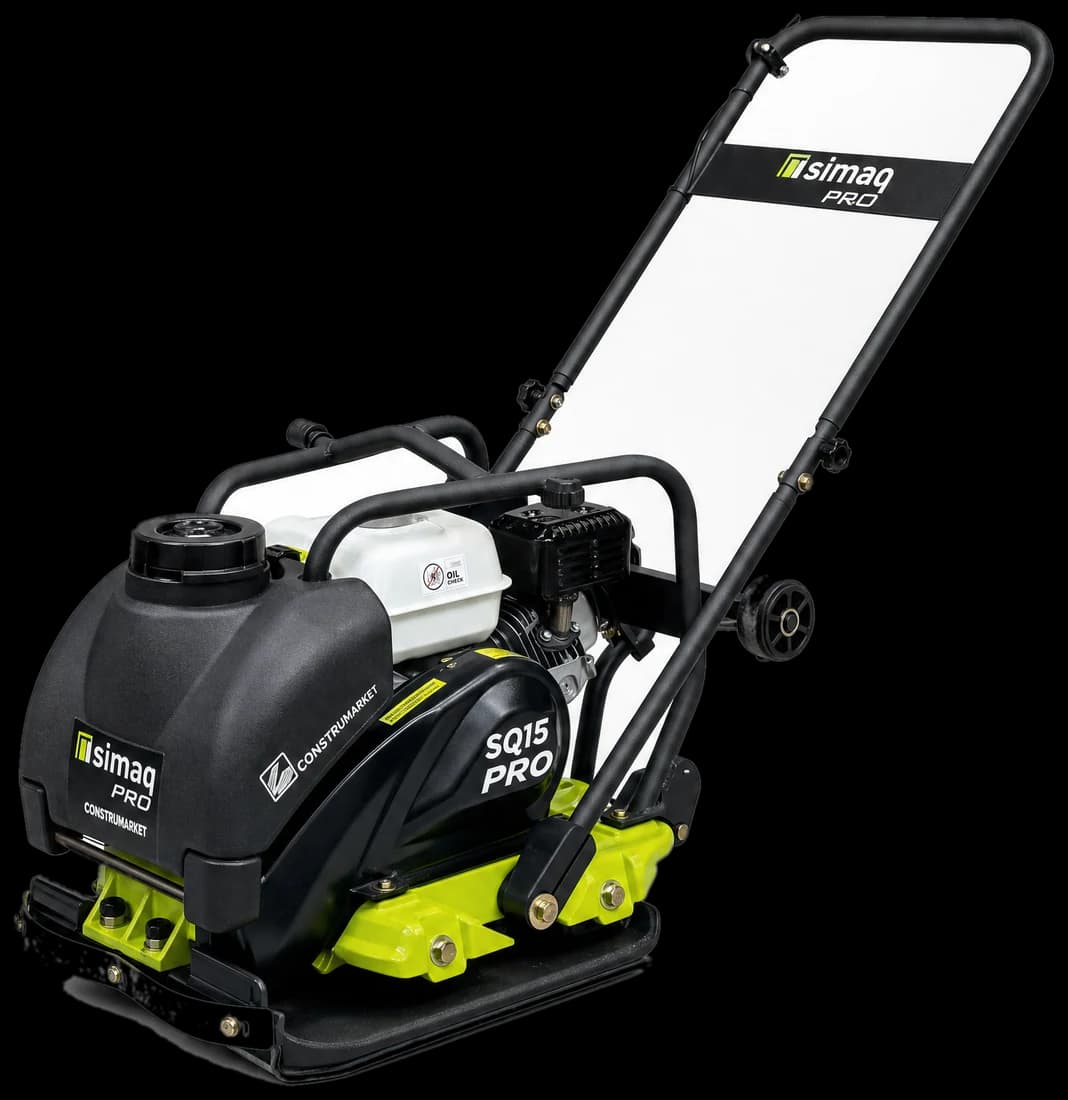
SQ15 PRO
Plate compactor SQ15 PRO
Even base and paver compaction, tireless feed.
View details5-minute training
5 minRun a plate compactor at full throttle, in straight overlapping lanes, over 20–30 cm lifts of granular soil, base or pavers, with 3–4 passes per lift. The SIMAQ SQ15 PRO (Honda GX160, 530 × 500 mm plate, 13.0 kN) compacts down to 300 mm and comes with a 12 L water tank for asphalt and a urethane mat for pavers. What ruins it: clay, half throttle, or asphalt without water.
Also called: vibratory plate, plate compactor
The plate compacts by high-frequency vibration: it settles sand, gravel and base grains so no voids are left. If the soil is granular or you're bedding pavers, it's your machine; for clay or the floor of a narrow trench, use the rammer.
Engine and exciter oil, clean air filter and no packed dirt on the plate. For asphalt, fill the water tank; for pavers, fit the urethane mat.
Spread 20–30 cm lifts. If the material is dry and loose, sprinkle it; if it's soaked, let it dry out: the plate sinks and pumps mud.
Start at idle and go to full throttle before moving off. At half throttle the vibration loses force, the plate hops and doesn't compact.
Travel in straight lanes overlapping ~15 cm, from the edges toward the center, 3–4 passes per lift. When the plate starts to hop and leaves no mark, that lift is done.
On pavers, always with the urethane mat so you don't chip the blocks. On asphalt, open the sprinkler before you start: a dry plate picks up the mix and tears it.
Do this
Avoid this
Safety
Test yourself
Each practice: do it or avoid it? Tap your answer.
Always run at full throttle.
Pavers → urethane mat and joint sand.
On asphalt, never run with the sprinkler closed.
On a slope → go straight up and down, never across.
Don't use it on clay or silt: cohesive soil ignores vibration.
Make sure the plate isn't dragging large stones that hammer it.
Don't leave it vibrating in one spot: it digs a hole and punishes the plate.
Don't compact lifts over 30 cm: the top gets hard and the bottom stays loose.
Equipment in this training
Shorts
Buying guides
Granular or cohesive, base or trench: the rule is simple — the soil decides. A quick guide so you don't over-buy or redo the work.
Read Guide · 8 minThe plate vibrates with an eccentric shaft driven by a belt; the rammer strikes with a connecting rod and springs. Each one's parts, how power gets from the engine to the ground and what to check and what wears.
Read Guide · 8 minClear it, bring it to the right moisture, spread thin lifts, make the passes and check before the next one. How thick each lift, how many passes with a plate or rammer, how to tell the moisture is right and how to know it's done.
ReadFAQ
Granular soil: sand, gravel, base, sub-base and paver bedding. If it's clay or silt, vibration won't compact it: use a rammer like the SQ60 PRO 2.
3 to 4 passes per 20–30 cm lift, overlapping each lane ~15 cm. When the plate starts to hop and leaves no mark, that lift is ready.
Granular soil or an open area → plate. Clay, silt or a narrow trench → rammer. The guide on what a plate compactor is and what it's for goes into detail.
Yes, for patching and small areas, always with the sprinkler open so the mix doesn't stick. The SQ15 PRO has a 12 L water tank; for streets and large areas, a roller is the better fit.
Running it at half throttle or on lifts that are too thick. At half throttle it hops and doesn't compact; with lifts over 30 cm the surface gets hard and the bottom stays loose.
Get a quote without leaving
Want to work it out with an advisor?
Tell us about the job and we'll build the package. A rep replies during business hours.