Guide · 5 min
Which cutting blade should you use for concrete, asphalt or stone?
Also called: diamond blade, saw blade, floor saw blade
By the SIMAQ technical team · Grupo ConstruMarket ·
Short answer
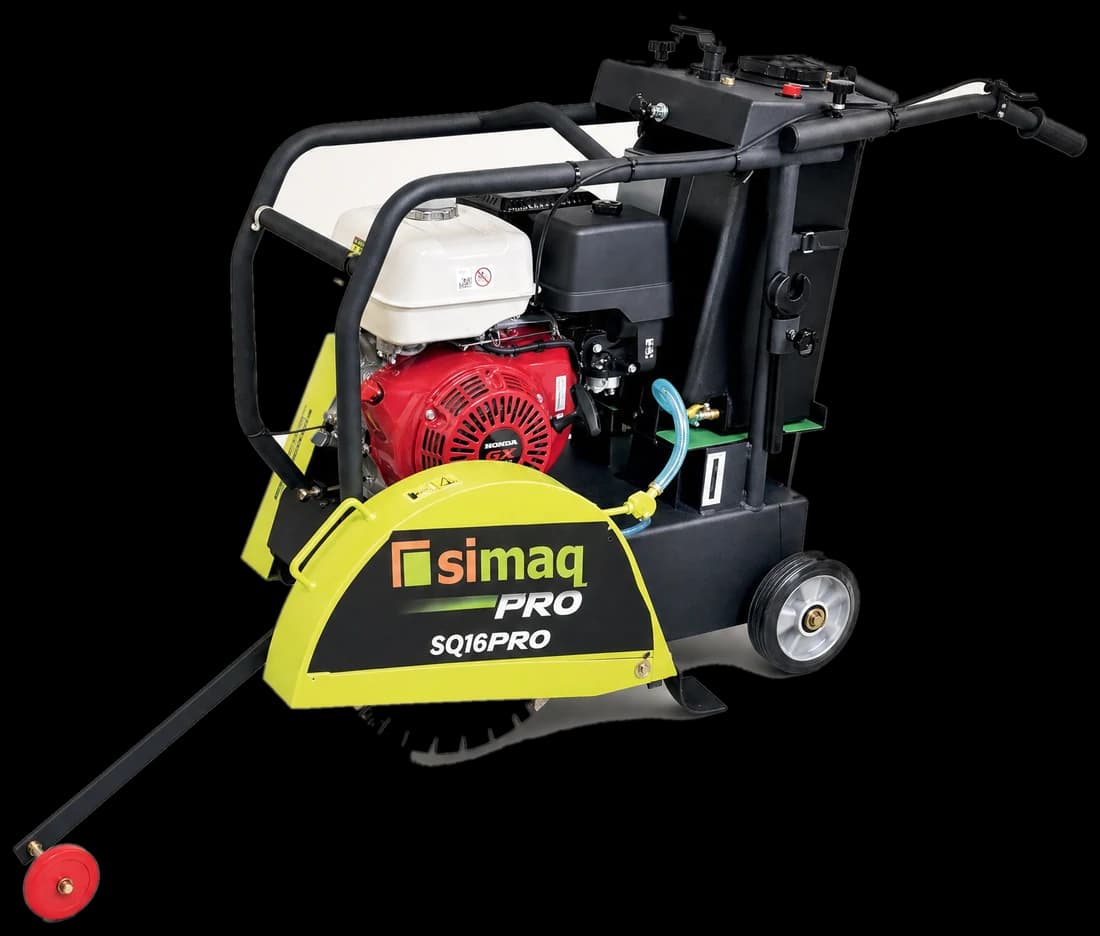
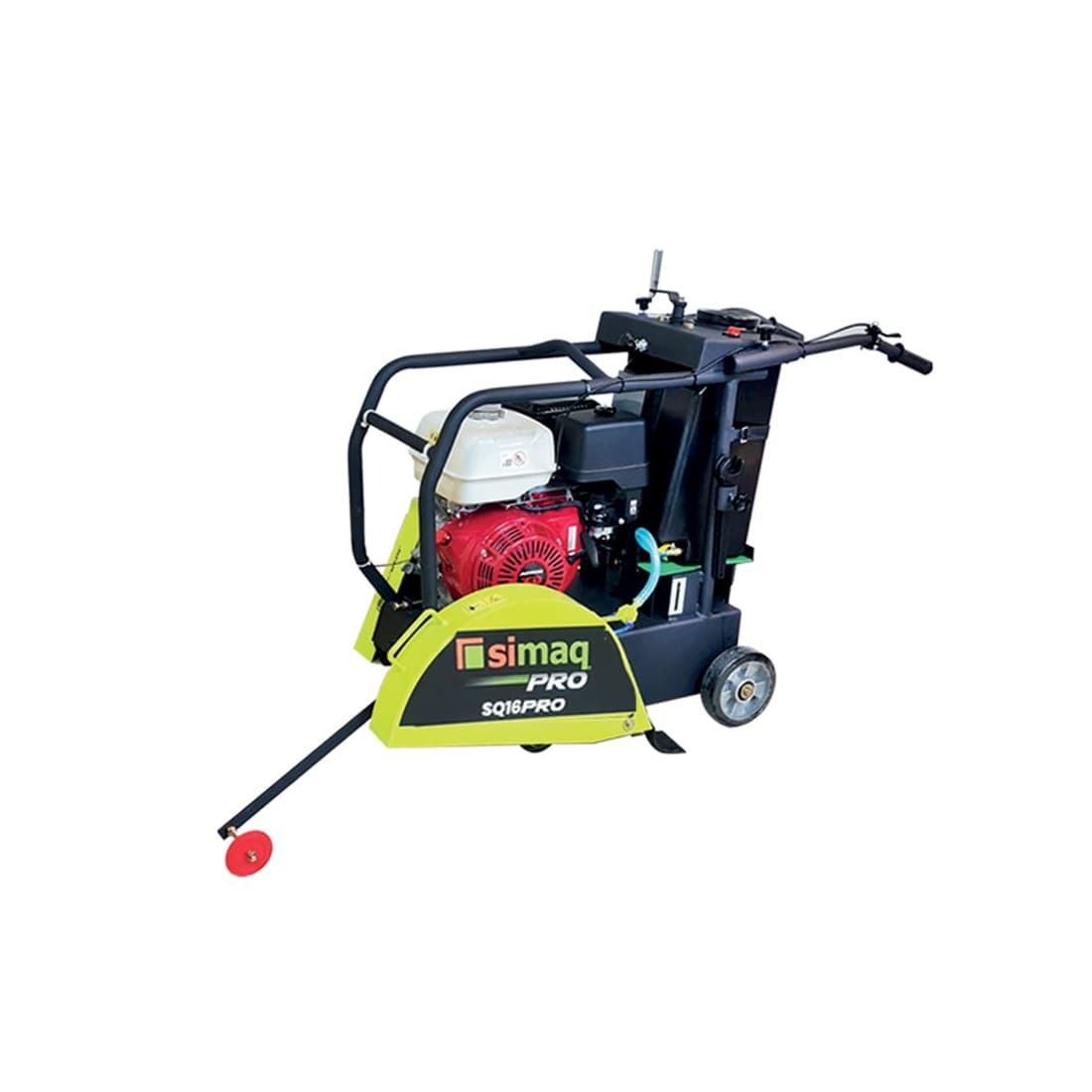
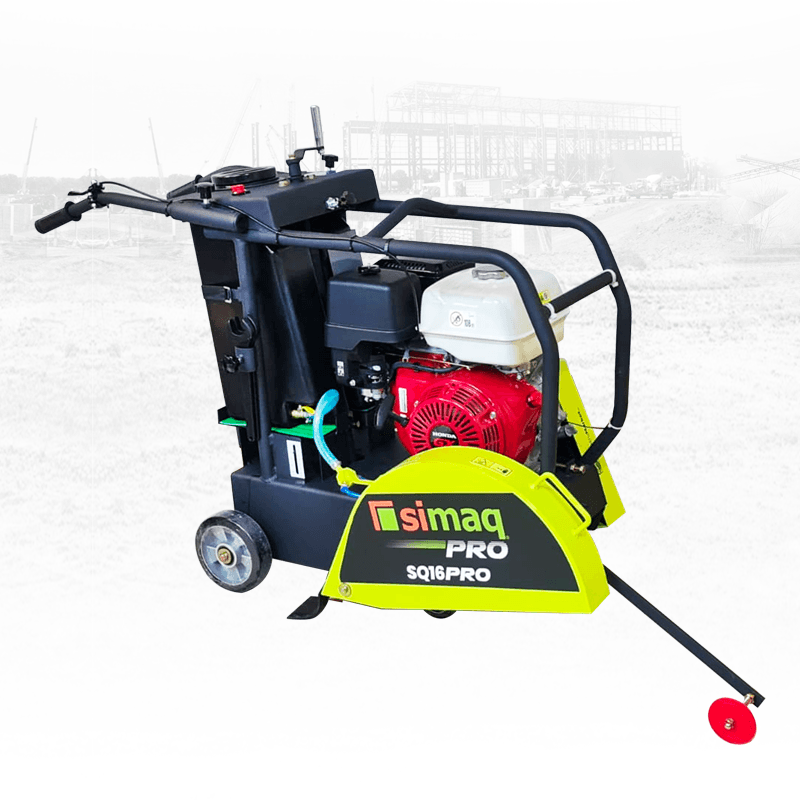
Use a diamond blade made for the material you're cutting. For cured concrete, a concrete blade with a softer bond; for asphalt and green concrete, which are abrasive, an asphalt blade with a hard bond; for hard stone such as granite, a stone blade. Diameter sets the depth: the SIMAQ SQ16 PRO saw takes 300 to 450 mm (12 to 18″) blades, cuts up to 130 mm deep and comes with two 400 mm concrete blades. Always cut wet and in passes.
blades the SQ16 PRO takes
max cutting depth
concrete blades included
How a diamond blade cuts (and why there are several)
A diamond blade has no edge: its rim carries segments with industrial diamond set in a metal bond. The diamond scratches the material; the bond wears away and exposes fresh diamond. The whole trick is for the bond to wear at the right speed for your material.
That's why the rule looks backwards: hard material, soft bond (so fresh diamond keeps coming out); abrasive material, hard bond (so grit doesn't eat the segment). General-purpose blades exist, but in each material they do less than the right one.
Concrete: cured or freshly poured
Cured concrete is hard, even more so with hard river or crushed aggregate: it calls for a concrete blade with a softer bond. That's what the SQ16 PRO ships with, two 400 mm blades.
Freshly poured concrete, when you saw control joints early, is still soft and abrasive: it chews through a cured-concrete blade. For that cut, use a green-concrete or asphalt blade with a hard bond. If you don't know your concrete's aggregate, tell your advisor: it changes the recommended blade.
Asphalt: abrasive, needs a hard bond
Asphalt cuts easily, but it's very abrasive: the sand and gravel in the mix wear the segment and the blade body. An asphalt blade has a hard bond and, on many models, protection against body wear under the segments.
If there's a concrete slab under the asphalt layer, say so when you quote: one blade isn't ideal for both materials, and it pays to plan which goes on each stretch.
Stone, curbs and pavers
Hard natural stone, like granite, calls for a stone blade with a soft bond. But watch the name: a concrete curb or paver cuts like concrete, not like stone. The question is always what it's made of, not what the piece is called.
Diameter, depth, arbor and speed
- Larger diameter, more depth. The SQ16 PRO cuts up to 130 mm with 300 to 450 mm blades.
- For control joints at ¼ of slab thickness, you rarely need the largest blade.
- The blade bore must match the saw's arbor: confirm it with your advisor.
- The max speed marked on the blade must be equal to or higher than the saw's arbor speed.
- Respect the rotation arrow marked on the blade.
How to tell you picked the wrong blade
At ConstruMarket branches in El Salvador, Guatemala (CMARKET), Nicaragua and Panama. Request a quote from this guide and an advisor in your country will confirm the model and availability.
| If you see… | It means… | Do this |
|---|---|---|
| The blade stops advancing and the segment looks smooth and shiny | It glazed: the bond is too hard for the material | Dress it with a few cuts in abrasive material and switch to a softer bond |
| The segment wears very fast | The bond is too soft or the material is abrasive | Switch to a hard bond (asphalt or green-concrete blade) |
| The blade turns blue or warps | It's short of water or you're forcing it | Open the water, take shallower passes and don't push |
| A cracked or loose segment | The blade is no longer safe | Replace it right away |
Common mistakes
- Using the same blade on cured concrete, green concrete and asphalt.
- Cutting dry with the SQ16 PRO: it has a 30 L water tank for a reason.
- Trying to reach full depth in one go: cut in passes of 2 to 5 cm.
- Mounting a blade rated below the saw's speed or with a bore that doesn't fit.
- Forcing curves: a floor saw cuts in straight lines.
Takeaway
Pick the blade by the material: cured concrete, concrete blade (softer bond); asphalt and green concrete, asphalt blade (hard bond); hard stone, stone blade. The SQ16 PRO takes 300 to 450 mm blades, cuts up to 130 mm and comes with two 400 mm concrete blades. Cut wet, in passes, and change the blade if it glazes or wears too fast.
Keep going
Frequently asked
Which blade do you use to cut asphalt?
A diamond asphalt blade with a hard bond, because asphalt is abrasive. Cut wet and in passes.
Can I cut asphalt with a concrete blade?
It will cut, but a concrete blade has a softer bond and asphalt eats it fast. For a short stretch it can do; for steady work, use an asphalt blade.
What blade size does the SQ16 PRO take?
300 to 450 mm (12 to 18″). It ships with two 400 mm (16″) concrete blades and cuts up to 130 mm deep.
How do I know the blade has glazed?
It stops advancing even though the engine runs fine, and the segment looks smooth and shiny. Dress it with a few cuts in abrasive material and, if it happens again, switch to a softer-bond blade.
Where can I buy blades and the SQ16 PRO saw?
At ConstruMarket branches in El Salvador, Guatemala (CMARKET), Nicaragua and Panama. When you quote, say what material you're cutting and the concrete's aggregate.