Guide · 7 min
Parts of a concrete and asphalt saw: blade, engine, water and depth
Also called: floor saw, road saw
By the SIMAQ technical team · Grupo ConstruMarket ·
Short answer
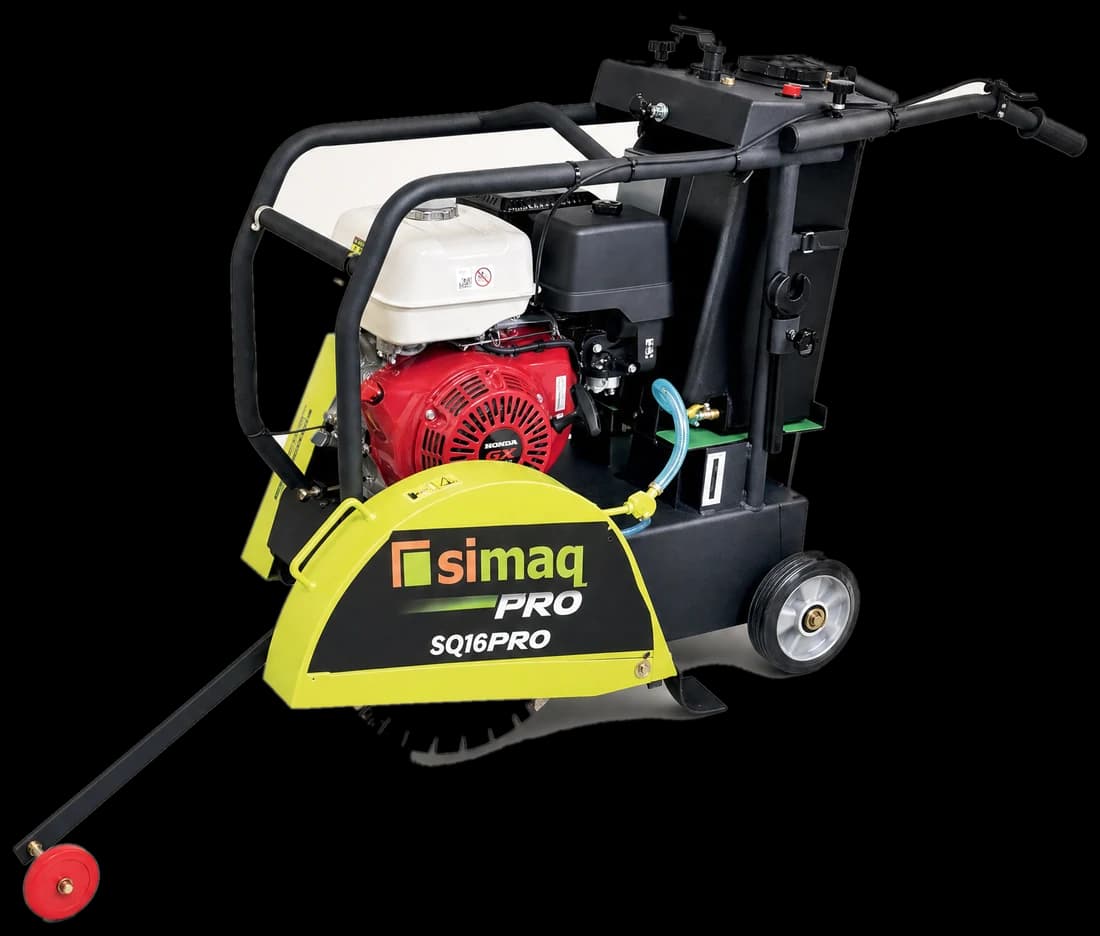
A floor saw has five groups of parts. The cut: the diamond blade, clamped between two flanges on the main shaft and covered by the guard. The power: the engine and the belts that drive the blade shaft. The water: a tank with its valve and a pipe that wets the blade. Depth and guidance: a crank with a jack that raises and lowers the blade, and a pointer at the front to follow the line. And the frame with its wheels, plus the handlebar with the throttle.
SQ16 PRO maximum depth (spec sheet)
blade sizes it takes (spec sheet)
water tank (spec sheet)
The saw's parts at a glance
These are the names from the parts list in the SIMAQ SQ16 PRO manual, a saw with a 13 HP Honda GX390 engine. Floor saws of this type are built the same way.
| Part | What it does |
|---|---|
| Diamond blade | Does the cutting. One for concrete and another for asphalt: the SQ16 PRO comes with two 400 mm concrete blades. |
| Blade flanges | The two collars that clamp the blade to the main shaft. |
| Blade guard | Covers the top of the blade and carries water to the cut. |
| Engine | A 13 HP Honda GX390 on the SQ16 PRO. |
| Pulleys, belts and their cover | Carry the engine's spin to the blade's main shaft. |
| Tank, valve and water pipe | Supply the water that cools the blade and keeps dust down. |
| Crank and jackpost | Raise and lower the blade: that's where you set the depth. |
| Pointer (arm and pointer wheel) | Sits at the front: you line it up with the marked line to cut straight. |
| Frame, wheels, handlebar and throttle | Carry the machine, steer it and control engine speed. |
Blade, flanges and guard: the cutting end
The blade sits between an inner and an outer flange, clamped by the shaft nut. If the flanges are dusty, dented or worn, the blade runs crooked, vibrates and wears unevenly. The manual says to clean the flange faces before mounting it and to follow the blade's rotation arrow.
- Check the blade before every use: no cracks, dents or defects in the steel core or at the rim.
- Never work without the guard: no more than half the blade (180°) should ever be exposed.
- Never transport it with the blade fitted, and don't let the blade touch the ground when you move it.
- Use the blade for the material printed on it: a concrete blade isn't for asphalt.
Engine, pulleys and belts: how power reaches the blade
The engine turns a pulley; a set of belts (three on the SQ16 PRO, per its parts list) carries the spin to the transmission pulley on the blade's main shaft. The shaft runs on bearings held in brackets.
The belts are tensioned just enough: the manual says the best tension is the lowest at which they don't slip under full load. Too tight shortens their life and the bearings'. Check them often on the first day and periodically after that, and replace the whole set, not just one.
- Grease the blade-shaft bearings every day and check they have no play.
- Before switching off, let it idle without load for 2 to 5 minutes; then close the fuel valve.
- Don't tilt it too far: oil can run into the cylinder head and then it won't start.
Water: tank, valve and pipe
The SQ16 PRO's tank holds 30 litres. From there, a valve and a pipe carry the water to the guard, which spreads it over the blade. The water cools the blade and keeps the dust down: that's why wet cutting lasts longer and is healthier for the operator.
Before cutting, open the valve and check that water comes out evenly on both sides of the blade. If little comes out, check the pipe isn't clogged with mud.
Depth and guidance: crank, jack and pointer
Depth is set by hand. The crank moves the jack, which lowers or raises the blade; on the SQ16 PRO it reaches 130 mm. Lower the blade slowly and cut in passes, not all at once.
The pointer is an arm with a small pointer wheel at the front. Before starting, line it up with the blade, then follow it along the marked line: that keeps the cut straight without forcing the handlebar. Don't use the pointer or the handlebar to lift the machine.
What wears and what to check every day
| Part | What to check |
|---|---|
| Blade | Cracks, dents and wear; that it suits the material. |
| Flanges | Clean, no burrs, not worn or out of round. |
| Shaft bearings | Daily grease and no play. |
| Belts | Just enough tension; replace the full set. |
| Guard and water pipe | Fitted, secure and with water flowing evenly. |
| Wheels and axles | That they turn freely without wobble. |
| Engine | Oil, air filter (cutting dust clogs it) and fuel. |
Common mistakes
- Mounting the blade on dirty flanges: it runs crooked, vibrates and wears unevenly.
- Removing the guard «to see the line better»: that's what the pointer is for.
- Moving the saw with the blade fitted or letting it touch the ground.
- Tightening the belts to the limit: it shortens their life and the bearings'.
- Cutting dry with a blade made for wet cutting.
Takeaway
A floor saw is a blade with flanges and guard; an engine with pulleys and belts; a water tank, valve and pipe; a crank, jack and pointer for depth and line; and a frame with wheels and handlebar. What needs most care: clean blade and flanges, guard always on, even water, belts at just the right tension and daily greasing of the shaft. Ask for a quote here and an advisor in your country will confirm the blade or part you need.
Keep going
Take it to the job site
Print the checklist to go over it on site, or send the guide to your crew.
Frequently asked
What are the parts of a concrete saw?
Diamond blade, flanges and guard; engine, pulleys and belts; water tank, valve and pipe; crank and jack for depth; a pointer to follow the line; and frame, wheels and a handlebar with throttle.
What is the saw's pointer for?
To cut straight. It's an arm with a wheel at the front lined up with the blade; you follow the marked line with the pointer instead of watching the blade.
How do you set the cutting depth?
With the crank, which moves the jack to lower or raise the blade. On the SQ16 PRO the adjustment is manual and reaches 130 mm. Cut in passes, not in one go.
Why does the saw vibrate when cutting?
The usual causes are dirty, dented or worn flanges, a damaged or reversed blade, or shaft bearings with play. Check those three things before carrying on.
What blade size does the SQ16 PRO take?
From 300 to 450 mm (12 to 18 inches), per its spec sheet. It comes with two 400 mm concrete blades.
SIMAQ · Job site checklist
Parts of a concrete and asphalt saw: blade, engine, water and depth
A floor saw has five groups of parts. The cut: the diamond blade, clamped between two flanges on the main shaft and covered by the guard. The power: the engine and the belts that drive the blade shaft. The water: a tank with its valve and a pipe that wets the blade. Depth and guidance: a crank with a jack that raises and lowers the blade, and a pointer at the front to follow the line. And the frame with its wheels, plus the handlebar with the throttle.
Blade, flanges and guard: the cutting end
- Check the blade before every use: no cracks, dents or defects in the steel core or at the rim.
- Never work without the guard: no more than half the blade (180°) should ever be exposed.
- Never transport it with the blade fitted, and don't let the blade touch the ground when you move it.
- Use the blade for the material printed on it: a concrete blade isn't for asphalt.
Engine, pulleys and belts: how power reaches the blade
- Grease the blade-shaft bearings every day and check they have no play.
- Before switching off, let it idle without load for 2 to 5 minutes; then close the fuel valve.
- Don't tilt it too far: oil can run into the cylinder head and then it won't start.
Avoid
- Mounting the blade on dirty flanges: it runs crooked, vibrates and wears unevenly.
- Removing the guard «to see the line better»: that's what the pointer is for.
- Moving the saw with the blade fitted or letting it touch the ground.
- Tightening the belts to the limit: it shortens their life and the bearings'.
- Cutting dry with a blade made for wet cutting.
Job site:
Date:
Supervisor:
Scan it for the full guide, with video and FAQ
https://simaq.pro/en/recursos/partes-de-una-cortadora-de-concreto