

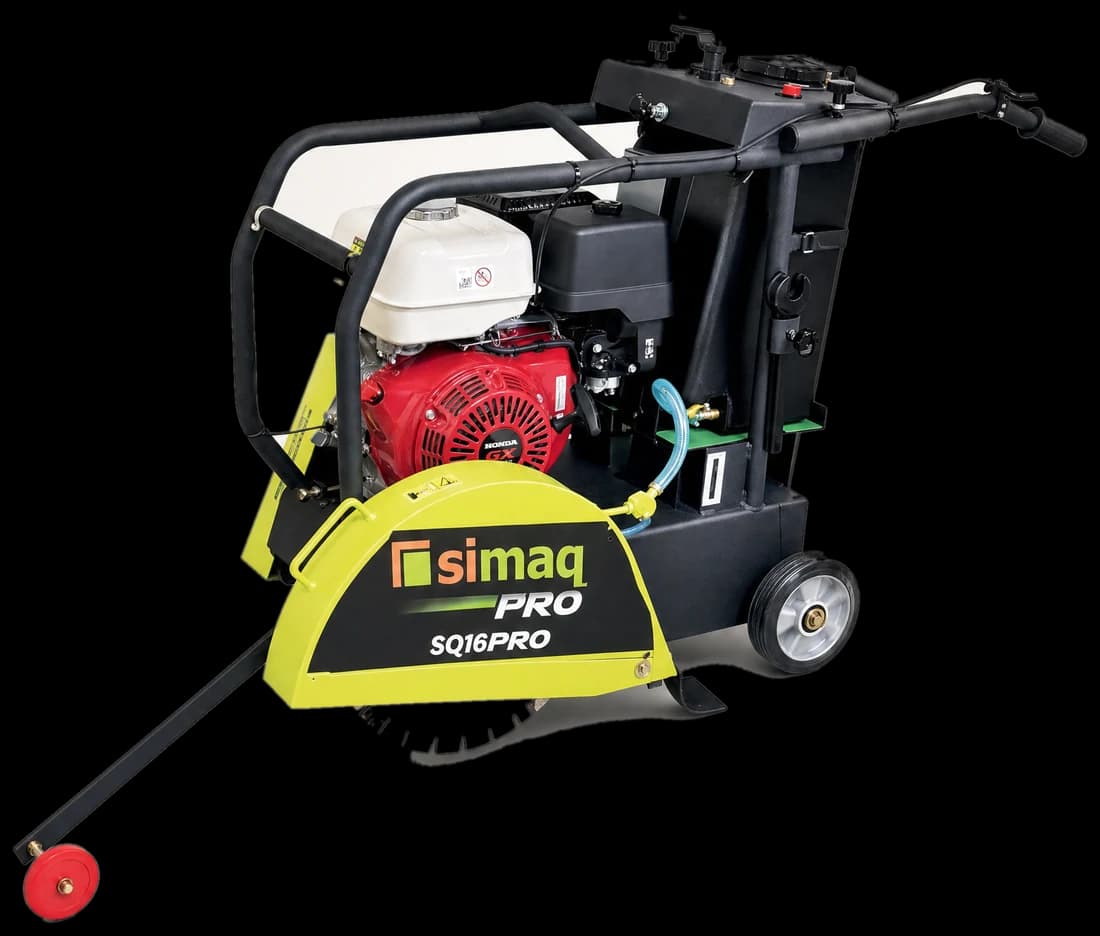
SQ16 PRO
Concrete & asphalt saw SQ16 PRO
Straight, deep cuts in slab and roadway.
View detailsFree tool · SIMAQ
Short answer
You choose the blade by the material: cured concrete → concrete blade, softer bond; asphalt and green concrete → hard bond, because they're abrasive; hard stone → stone blade. Control joints go at ¼ of slab thickness and are cut wet, in passes of 2 to 5 cm. The SQ16 PRO takes 300 to 450 mm blades and cuts up to 130 mm.
SIMAQ · Which cutting blade?
The blade
Diamond blade for concrete
Softer bond
Cured concrete is hard: a soft bond wears and exposes fresh diamond. It's what the SQ16 PRO ships with.
Joint at ¼ of thickness: 30 mm · 1 to 2 passes of 2 to 5 cm · the SQ16 PRO reaches (up to 130 mm, 300 to 450 mm blades).
| If you see… | Do this |
|---|---|
| It stops advancing and the segment looks smooth and shiny | It glazed: bond too hard. Dress it with a few cuts in abrasive material and switch to a softer bond. |
| The segment wears very fast | Bond too soft or abrasive material: switch to a hard bond (asphalt or green-concrete blade). |
| The blade turns blue or warps | Short of water or forcing it: open the water, take shallower passes and don't push. |
| A cracked or loose segment | The blade is no longer safe: replace it right away. |
Every result is a reference estimate. It doesn't replace a professional's design or supervision.
Because cured concrete is hard: the bond must wear so fresh diamond comes out. With a hard bond, the blade glazes and stops cutting.
It cuts, but asphalt is abrasive and eats the soft bond: the blade lasts much less. Use an asphalt blade with a hard bond.
To ¼ of slab thickness. On a 12 cm slab, 3 cm.
If they're concrete, no: they cut like concrete. The question is what the piece is made of, not what it's called.
The machine for the job
Send us the result and an advisor contacts you during business hours.