
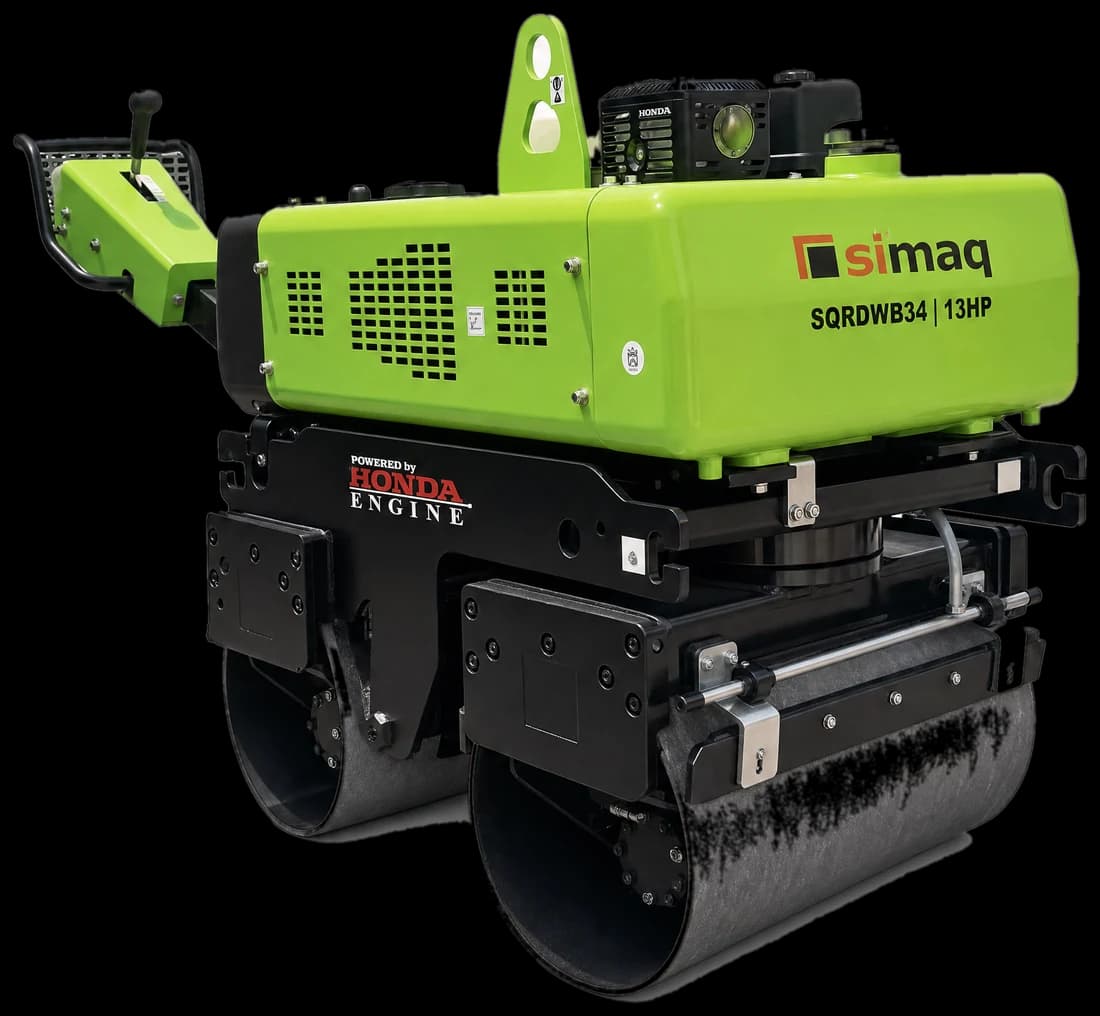
SQRDWB L34
Walk-behind double-drum roller SQRDWB L34
Double vibrating drum for asphalt and base.
View details5-minute training
5 minA roller is a machine with steel drums that compacts base, walkways and asphalt with its weight and, if it's vibratory, with vibration. The SIMAQ SQRDWB L34 is a walk-behind vibratory double-drum roller with 680 mm drums, a Honda GX390 engine and 17 kN of force. Bring the engine to full throttle before vibrating, overlap a third of the drum on each lane and keep the sprinkler open on asphalt.
Also called: walk-behind roller, double-drum roller, vibratory roller
The roller compacts in wide lanes and leaves a smooth surface: that's why it's used on base, sub-base, walkways, parking lots and asphalt patching. The walk-behind fits where a big roller won't; for a whole street, a ride-on is the better fit.
Engine, hydraulic and fuel levels. Fill the water tank and confirm spray on both drums.
Position the machine, bring the engine to full throttle, and only then engage vibration (it won't kick in at low rpm). Move the travel lever smoothly.
On asphalt, the first pass goes without vibration to bed the mix; then vibrate to densify. On granular base, you can vibrate from the first pass.
Each lane covers a third of the previous one. Roll forward and back on the same line at a steady speed for an even finish.
Switch vibration off before braking or reversing. To finish, make one pass without vibration to erase marks and leave a smooth surface.
Do this
Avoid this
Safety
Test yourself
Each practice: do it or avoid it? Tap your answer.
Use the lifting point to load and unload it.
Don't roll asphalt with the water tank empty.
Don't forget the brake when parking on a slope.
Work at a steady speed: not crawling, not racing.
Keep the sprinkler open on asphalt so it won't stick.
Don't leave it vibrating stationary on asphalt: it dents it.
Don't vibrate near a slab, pipe or structure without assessing.
If the soil is clay → use a padfoot roller or a rammer: a smooth drum won't knead cohesive soil.
Equipment in this training
Buying guides
Granular or cohesive, base or trench: the rule is simple — the soil decides. A quick guide so you don't over-buy or redo the work.
Read Guide · 8 minClear it, bring it to the right moisture, spread thin lifts, make the passes and check before the next one. How thick each lift, how many passes with a plate or rammer, how to tell the moisture is right and how to know it's done.
Read Guide · 6 minThe SQ15 PRO plate compacts about 143 m² per hour of finished lift in sand or gravel (4 passes), and about 114 m²/h in mixed soil. Where the number comes from, how to do your own maths and when to step up to a roller.
ReadFAQ
It's a compaction roller: a machine with steel drums that presses soil or asphalt down with its weight and, if it's vibratory, with vibration. In Central America it's called a «rodo»; elsewhere, a roller or vibratory compactor.
It's a roller that vibrates its drums on top of its weight, so it compacts more with fewer passes. The SQRDWB L34 vibrates at 65 Hz; engage vibration at full throttle and switch it off for the final pass.
Patching, walkways, wide trenches or a yard → a walk-behind like the SQRDWB L34. Streets, large parking lots or embankments → a ride-on (SQRD L41 to L71). To choose by weight, see the guide on which roller to pick by tonnage.
Generally 3–4 passes per 20–30 cm lift, overlapping a third of the drum. On asphalt: a static pass, the vibratory passes, and a final static pass to seal.
Because the sprinkler is off or the tank ran dry. Fill the tank before you start and check that water reaches both drums.
On the SQRDWB L34, the first engine-oil change is at 50 hours and then every 100 hours; check the level every 10 hours. Hydraulic oil is changed every 500 hours.
Get a quote without leaving
Want to work it out with an advisor?
Tell us about the job and we'll build the package. A rep replies during business hours.