
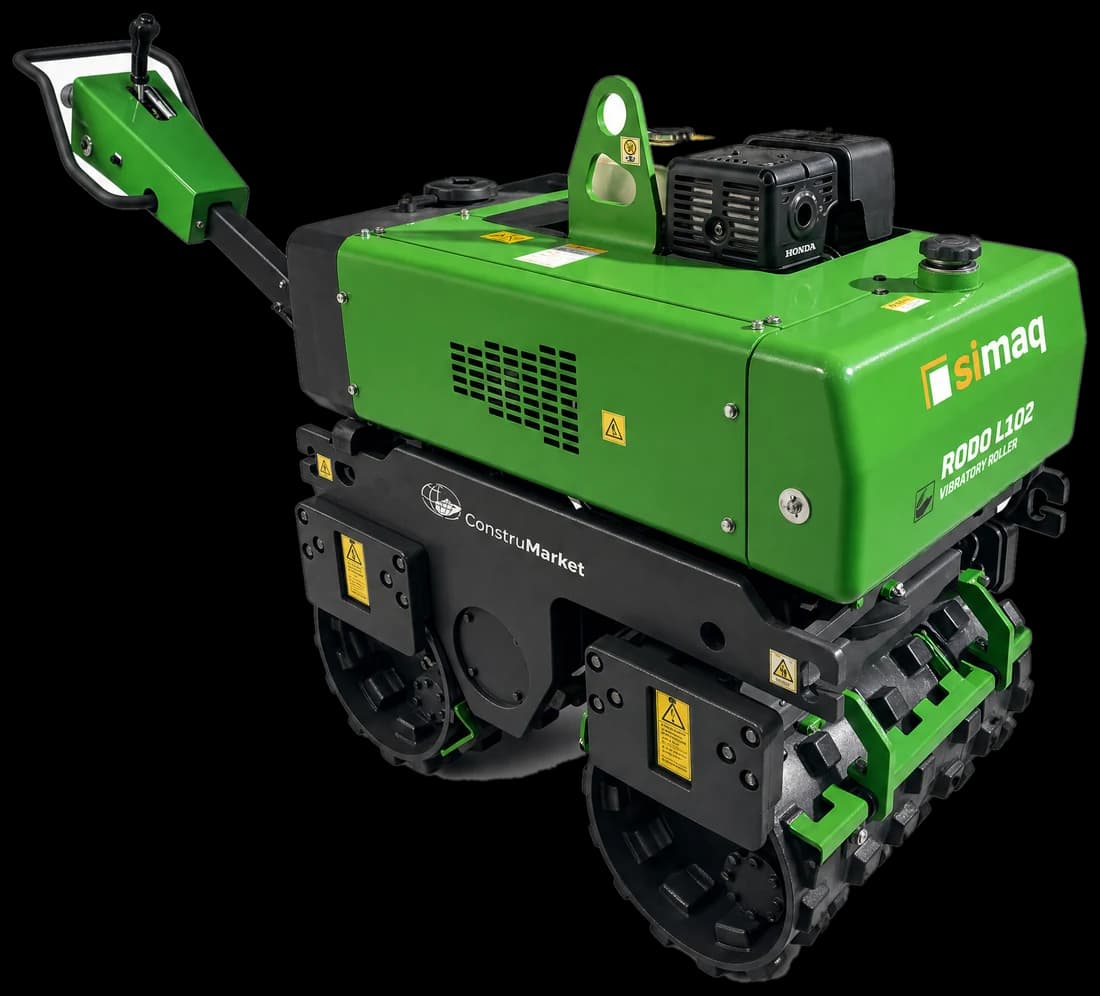
SQRDPWB L102
Trench roller SQRDPWB L102
Compacts the trench floor, remote-control ready.
View details5-minute training
5 minA walk-behind trench roller compacts trench floors and backfill in clay soil, steered by its handle. The SIMAQ SQRDPWB L102 has 680 mm double padfoot drums, a Honda GX390 engine and 17 kN of centrifugal force. Go to full throttle before engaging vibration and work in 20–30 cm lifts with 4–6 overlapping passes.
Also called: trench roller, padfoot roller
Walk-behind double-drum padfoot roller: compacts the trench floor in cohesive soil, guided by the handle (no remote control).
Engine and hydraulic oil, fuel and water. Padfoot lugs free of packed-in material between them.
Position the machine, bring the engine to full throttle, and only then engage vibration (it won't kick in at low rpm). Guide with the handle, don't force it.
20–30 cm lifts, 4–6 overlapping passes. The padfoot kneads cohesive soil from the bottom up.
The articulated joint steers around covers and obstacles without tearing up fresh work. Smooth turns from the handle.
Keep your body behind the handle, never between the machine and the trench wall. Check slope and shoring before going in.
Do this
Avoid this
Safety
Test yourself
Each practice: do it or avoid it? Tap your answer.
Go to full throttle before engaging vibration.
Keep your body behind the handle at all times.
Clean the padfoot lugs at the end of the shift.
Don't stand between the machine and the trench wall.
Don't operate with the trench shoring in poor condition.
Don't use it as a finish smooth roller: it leaves lug marks.
Equipment in this training
Buying guides
Granular or cohesive, base or trench: the rule is simple — the soil decides. A quick guide so you don't over-buy or redo the work.
Read Guide · 7 minFrom 0.78 to 4.2 tonnes: the seven SIMAQ rollers side by side, with weight, drum width, force and engine, and which roller compactor fits sidewalks, trenches, streets or roadwork.
Read Guide · 6 minThe rammer compacts by impact: narrow trenches, next to pipe and walls, and clay soils. How to use it, when not to, and the SIMAQ SQ60 PRO 2.
ReadFAQ
A padfoot has lugs that dig in and knead clay soil; a smooth drum presses with a flat drum and leaves a smooth surface. Cohesive soil → padfoot; granular base or asphalt → smooth drum.
Shallow, stable trench → walk-behind (SQRDPWB L102). Deep trench or questionable walls → remote control (SQRPTRC L202), so nobody goes down with the machine.
4 to 6 overlapping passes per 20–30 cm lift. Any thicker and the bottom never compacts.
Standing between the machine and the trench wall: a turn or a bounce can pin you. Keep your body behind the handle, always.
On the SQRDPWB L102: first engine-oil change at 50 hours, then every 100 hours; check the level every 10 hours and change the hydraulic oil every 500 hours.
Get a quote without leaving
Want to work it out with an advisor?
Tell us about the job and we'll build the package. A rep replies during business hours.