

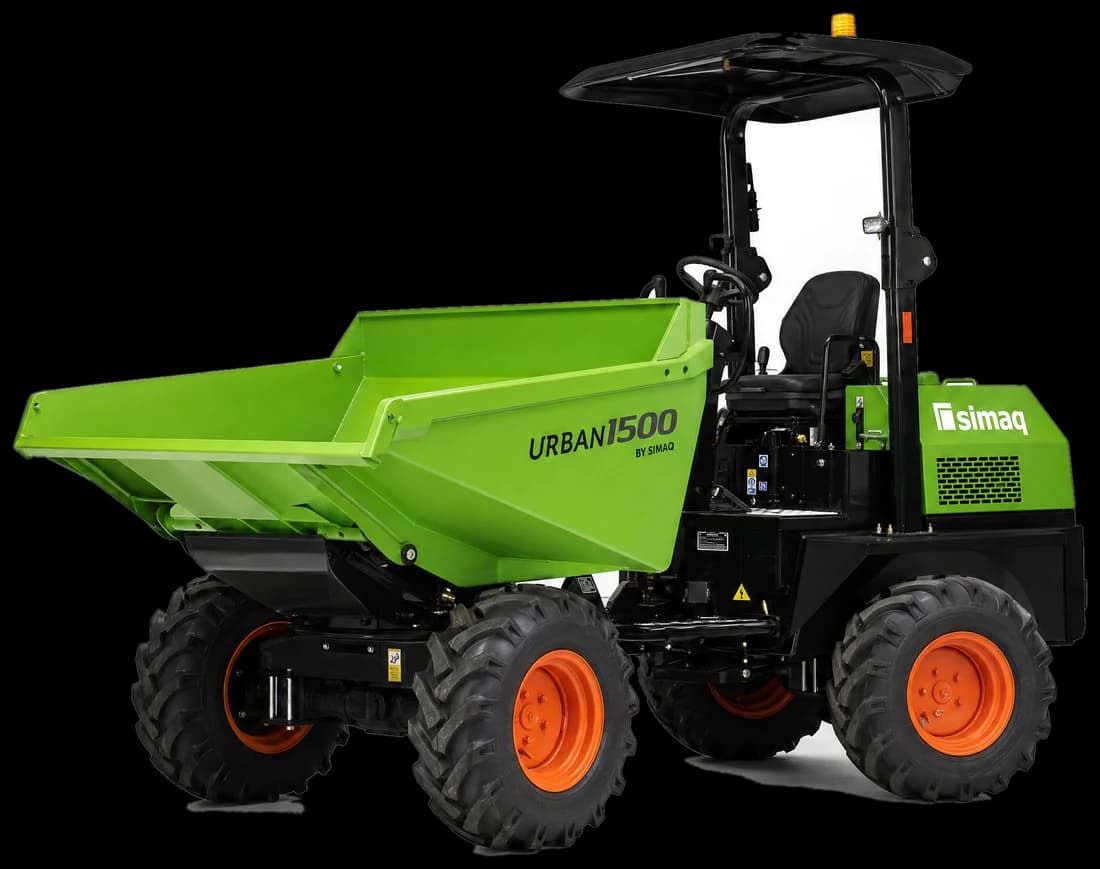
SQURBAN1500
Hydraulic dumper SQURBAN1500
4×4 site dumper for moving material where trucks can't reach.
View details5-minute training
5 minA dumper is a compact site tipper that carries sand, gravel, rubble or concrete over rough ground and unloads by tipping its skip. The SIMAQ Urban 1500 (SQURBAN1500) has a Yanmar diesel engine, 4×4 drive, hydraulic tipping and a 14 km/h top speed. Run it with the load centered, at walking pace when loaded or on bad ground, and tip only on firm ground, away from edges.
Also called: site dumper, mini dumper, power barrow
The dumper takes over from the wheelbarrow when distance, volume or terrain are wearing the crew out. Used right it's simple: centered load, slow when loaded, and tip on firm ground away from trenches and slopes.
Engine and hydraulic oil levels, leaks, brakes, tires and that the skip tips and returns freely. If you see a hydraulic leak, don't use it until it's fixed.
Center the weight in the skip, with no heap to spill on the way. Don't exceed the Urban 1500's 1,500 kg payload: with concrete or wet sand you reach the weight before filling the skip. Overloaded it gets unstable and punishes the brakes.
Loaded or on bad ground, walking pace. On a steep grade, drive up forward and come down in reverse, so the loaded skip is always on the uphill side.
Stop, set the brake, check the ground will hold and nobody is in front of the skip, then tip. Next to trenches or slopes, use a wheel stop.
Bring the skip back down before you drive off. Move or turn with the skip raised and the center of gravity climbs: it can tip over.
Do this
Avoid this
Safety
Test yourself
Each practice: do it or avoid it? Tap your answer.
Respect the skip's rated capacity.
Keep the dump zone clear of people.
Don't drive or turn with the skip raised.
Don't carry people in the skip or on the sides.
Don't tip with a wheel over a slope or trench edge.
Use a wheel stop when tipping next to trenches or slopes.
Don't drive across a slope loaded: it's the most common way to roll it.
Loaded on a slope → drive up forward, come down in reverse, always slowly.
Equipment in this training
Buying guides
When a wheelbarrow is enough, when a 4×4 dumper like the Urban 1500 multiplies progress and when you need a skid steer. Simple criteria and common mistakes.
Read Guide · 7 minLight towers, 3″ and 4″ dewatering pumps, cutting, demolition and compaction: the flood equipment worth having ready, how much water each pump moves and how to check it all before the season.
Read Guide · 6 minMunicipal flood response equipment by task and by crew: lighting, dewatering, cutting and reopening access, with the pump maths and what to specify when you buy.
ReadFAQ
It's a compact tipper for moving material around the site: sand, gravel, rubble or fresh concrete. It earns its place when the wheelbarrow can't keep up because of distance, volume or terrain.
A few short trips on firm ground → wheelbarrow. Many trips, long hauls or rough ground → dumper. If you also need to load with the machine or move earth → skid steer. The guide on dumper vs. wheelbarrow vs. skid steer compares them in detail.
Per its spec sheet, a 1,500 kg payload, with an 829 L struck and 1,044 L heaped skip. Whichever fills first rules: with heavy material you reach 1,500 kg before filling the skip; with light material you fill the skip before reaching the weight.
It depends on the material. With fresh concrete (about 2,400 kg per m³, a typical value) weight is the limit: about 0.6 m³ per trip, without filling the skip. With loose sand or gravel (1,500 to 1,700 kg per m³, depending on moisture) it fits struck, about 0.8 m³; heaping it with wet material goes over 1,500 kg. If you don't know your material's weight, don't fill the skip blind: ask for it or weigh a load, and carry at most 1,500 ÷ that weight per m³ (with concrete, a struck skip would already weigh almost 2,000 kg).
When you have people doing nothing but hauling all day, the route is long, has a ramp or mud, or you're moving concrete that can't wait. One Urban 1500 trip carries up to 1,500 kg, and it climbs grades up to 40 % per its spec sheet. For a few short trips on firm ground, the wheelbarrow still wins.
Driving across a slope loaded, or moving with the skip raised. Loaded, go up forward and down in reverse, and lower the skip before you drive off.
On the Urban 1500, the first engine oil-and-filter change is at 50 hours, then every 250 hours. Check engine and hydraulic oil levels every day before starting.
Get a quote without leaving
Want to work it out with an advisor?
Tell us about the job and we'll build the package. A rep replies during business hours.