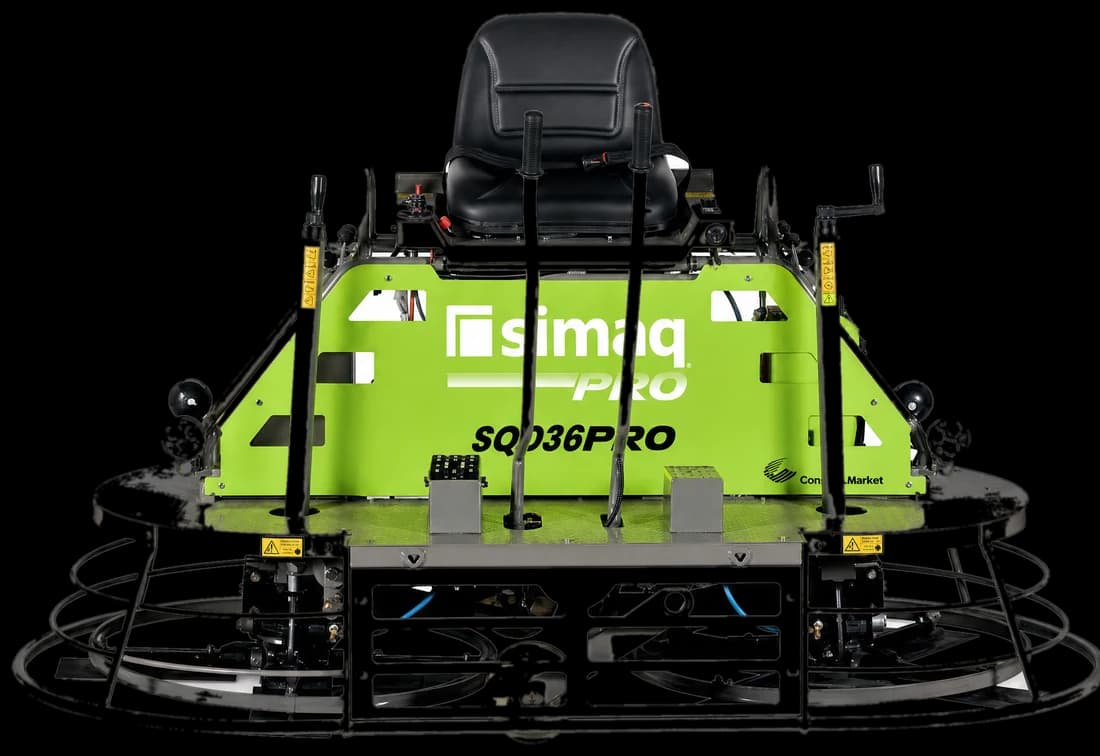

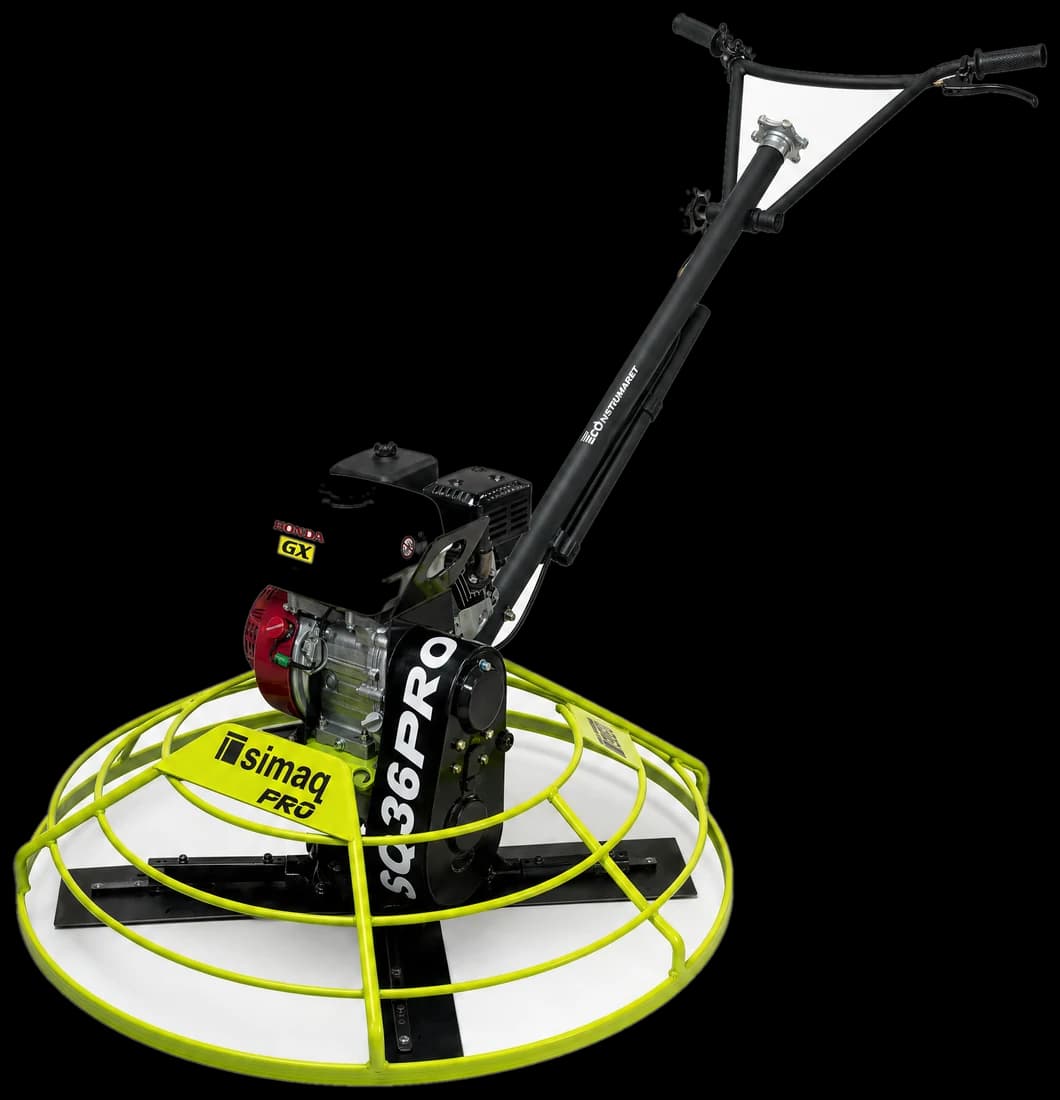
SQ36 PRO
Power trowel SQ36 PRO
Mirror slab finish, on schedule.
View details5-minute training
5 minUse a power trowel once the slab holds your footprint at 3–5 mm: first with the float pan, then with the blades, raising the pitch each pass and crossing directions. The SIMAQ SQ36 PRO (Honda GX160, 870 mm working diameter) comes with the float pan; for large areas there's the ride-on SQ36DOUBLE PRO with a Honda GX690 engine and 8 blades. Timing is everything: too early sinks the slab, too late won't finish.
Also called: power trowel, helicopter
The power trowel gives the slab its smooth or mirror finish. It's all about timing: get on when the concrete is just right, not before, not after. If the slab sets unevenly (sun on one side, shade on the other), start where it's furthest along.
The slab should hold your footprint at ~3–5 mm. If you sink deeper, wait; if it barely marks, get on now with the pan.
Fit the float pan for the first floating: it closes the surface and levels without marking. Even, overlapping sweeps.
Remove the pan and fit the blades. Raise the pitch a little each pass to keep closing and bringing up the shine; raise it all at once and the blades gouge.
Run one direction, then perpendicular. Crossing erases waves and leaves it truly flat.
Where the machine can't reach —edges and corners— finish by hand trowel so it matches.
Do this
Avoid this
Safety
Test yourself
Each practice: do it or avoid it? Tap your answer.
Keep spare blades ready: they wear out.
Adjust blade pitch gradually, pass by pass.
Don't leave it spinning in place on the slab.
Keep a steady pace; control is in your wrists.
If one area sets before the rest → start there.
Don't get on too early: you sink it and ruin the level.
Don't wait too long: hard concrete won't take a finish.
Don't throw water on the slab to 'revive' it: it weakens the surface.
Equipment in this training
Shorts
Buying guides
When to start curing, for how many days, with water, burlap, plastic or curing compound, and the mistakes that rob your slab or column of strength.
Read Guide · 6 minCut as soon as the slab bears the saw (usually 6–18 h) and at ¼ of the thickness. A depth-by-thickness table, where joints go and how to wet-cut with the SQ16 PRO.
Read Guide · 7 minMost SIMAQ light equipment runs a Honda GX engine. Oil, air filter and spark plug on time: the reference intervals, which engine each machine runs and the full routine on one page.
ReadFAQ
When the slab carries your weight and your footprint is 3–5 mm deep. Deeper, wait; barely marking, get on right away with the pan. The guide on when to trowel and what size to pick has the detail.
For the first floating pass: it closes the surface and levels it without marking. Then it comes off and the blades take over to finish and polish. The SQ36 PRO includes it.
Home slabs, corridors or medium areas → the walk-behind SQ36 PRO. Industrial slabs or large areas → the ride-on SQ36DOUBLE PRO, which covers far more per shift.
Getting on too early, raising the blade pitch all at once, or not crossing passes. Raise the pitch gradually and work in two directions.
Check engine and gearbox fluids every 8 hours, and lubricate the arms, thrust collar and clutch every 50 hours or weekly. Keep a spare blade set: they wear.
Get a quote without leaving
Want to work it out with an advisor?
Tell us about the job and we'll build the package. A rep replies during business hours.